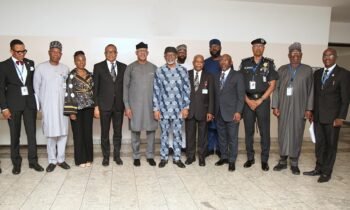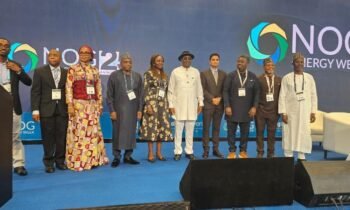

Chairman of the Board of Renaissance Africa Energy Company Limited, Dr. Layi Fatona.
Ayomide Bello
The Chairman of Renaissance Africa Energy Company Limited, Layi Fatona, has called on Nigeria to strengthen its resource resilience by diversifying across oil, gas and solid minerals in response to growing volatility in global energy markets.
Fatona made the call at the 61st Annual International Conference and Exhibition of the Nigerian Mining and Geosciences Society held in Uyo, Akwa Ibom State, where he warned that commodity price cycles, shifting energy geopolitics and rising security risks demand a more robust and forward-looking national strategy.
Represented by Renaissance Vice-President for Exploration, Johnbosco Uche, Fatona stressed that both government and corporate players must build systems capable of withstanding economic, environmental and security shocks.
Aligning his remarks with the conference theme on efficiency, sustainability and resilience, he said Nigeria must rethink how it manages its vast natural resources in the face of a fast-evolving global energy transition.
According to him, improving efficiency across the entire resource value chain—from exploration and development to production and market delivery—is critical. He urged operators to eliminate redundancies, shorten project timelines and improve recovery rates, noting that data-driven decision-making would be key to unlocking performance gains.
Fatona emphasised that infrastructure remains the backbone of resource monetisation, warning that natural endowment alone cannot translate into economic value without adequate support systems.
“Resource wealth without infrastructure is stranded potential,” he said, calling for sustained investments in transport networks, processing facilities, gas infrastructure and export corridors. He added that integrated planning across oil, gas and mining sectors would help unlock scale, lower costs and boost domestic value creation.
On sustainability, Fatona said the concept must move beyond regulatory compliance to become a core strategic principle. He advocated stronger environmental stewardship, inclusion of host communities and responsible resource utilisation to ensure long-term national prosperity.
He also highlighted the growing importance of technology in the extractive industries, pointing to innovations such as digital subsurface modelling, artificial intelligence and automation as critical tools for improving efficiency, safety and recovery rates. Real-time monitoring of infrastructure, he noted, would enhance reliability and reduce operational losses.
Fatona urged Nigeria to accelerate the adoption of such technologies to remain competitive in the global resource landscape.
He commended the administration of President Bola Tinubu for introducing executive orders aimed at improving the operating environment in the natural resources sector, describing the reforms as a positive signal for investors and industry players.
“These actions are empowering indigenous operators and improving the ease of doing business,” he said, adding that Nigeria’s large population, skilled workforce and vast resource base make industrialisation both achievable and imperative.
Fatona concluded by calling for deeper collaboration among government, industry stakeholders and investors to drive economic diversification and ensure sustainable growth across Nigeria’s resource sectors.