


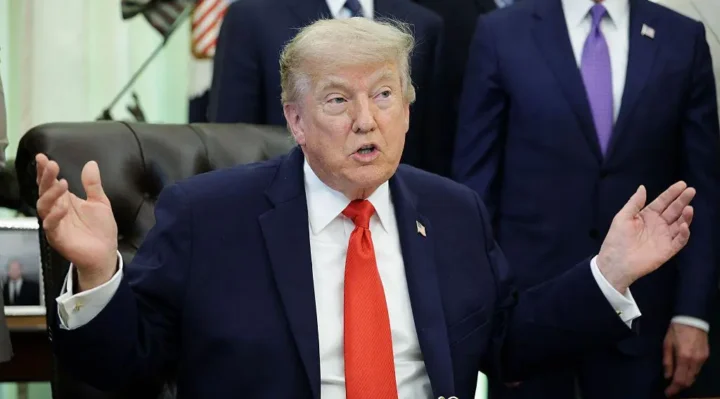


US President Donald Trump has warned that the United States could target Iran’s power plants and bridges as early as next week unless Tehran returns to negotiations, marking a sharp escalation in tensions that is rattling global energy markets and disrupting shipping through the Strait of Hormuz.
Speaking in an interview with Fox News, Trump said Iran faced severe military consequences if it refused to negotiate.
“Next week it gets really bad for them. We’re going to knock out all their power plants. We’re going to knock out all their bridges unless they get to the table and negotiate,” Trump said.
The remarks came as the United States and Iran exchanged military strikes for a fourth consecutive day, heightening fears of a broader regional conflict with significant implications for global oil supplies and maritime trade.
Threats Extend to Iran’s Energy Infrastructure
Trump indicated that Iran’s energy infrastructure could become a future target, saying military operations would eventually include energy facilities.
According to the US president, American negotiators also warned Iranian officials that they should “make a deal” or risk losing critical national infrastructure.
The comments revive concerns first raised in April, when Trump suggested targeting civilian infrastructure in Iran, including bridges and power plants.
The proposal drew international criticism, with UN High Commissioner for Human Rights Volker Türk warning at the time that deliberate attacks on civilian infrastructure could violate international humanitarian law. The Geneva Conventions prohibit attacks on facilities considered essential for civilian populations.
Strait of Hormuz Disruption Deepens Oil Market Concerns
The latest escalation coincides with mounting disruption in the Strait of Hormuz, one of the world’s most important energy shipping corridors through which roughly one-fifth of global oil supplies pass.
Shipping data indicates tanker traffic through the strategic waterway has slowed significantly, raising concerns over potential supply disruptions and pushing Brent crude prices higher.
Earlier this week, Trump abandoned a proposal to impose a 20% fee on cargo transiting the Strait of Hormuz, saying it would instead be replaced by expanded trade and investment agreements with Gulf states.
“I have decided to replace the 20% United States Reimbursement Fee with trade and investment deals,” Trump wrote on Truth Social, adding that Gulf investments in the US would be “massive.”
He also declared that the strait remained open to all commercial shipping except Iran, while reiterating that the US military would continue protecting maritime traffic.
US Intensifies Military Operations
The policy shift came shortly before the US military launched a seven-hour wave of strikes against Iranian military positions and resumed its blockade of Iranian ports.
US Central Command (CENTCOM) said the operation targeted dozens of Iranian military sites near the Strait of Hormuz to reduce Tehran’s ability to threaten commercial shipping and civilian vessels.
CENTCOM also accused Iran of attacking commercial shipping, stating that seven merchant vessels had been struck, resulting in civilian casualties among their crews.
The United Arab Emirates separately reported that Iranian cruise missiles struck two Emirati oil tankers, killing one Indian crew member and injuring eight others.
Iran’s Islamic Revolutionary Guard Corps later confirmed the attacks, claiming the vessels had ignored military warnings and attempted to transit through a mined maritime route.
Iran Rejects US Pressure
Iran dismissed Trump’s latest warnings, insisting that increased military and economic pressure would not force Tehran back to negotiations.
Deputy Foreign Minister Kazem Gharibabadi said Washington was mistaken if it believed military action and economic blockades would compel Iran to return to the negotiating table.
He also argued that the renewed US blockade of Iranian ports had effectively undermined an earlier memorandum of understanding that had temporarily eased tensions between the two countries.
Global Energy Markets on Alert
The renewed confrontation has heightened concerns across global energy markets, with traders closely monitoring developments around the Strait of Hormuz.
The waterway remains a critical chokepoint for crude oil exports from major Gulf producers, and any prolonged disruption could tighten global energy supplies, increase shipping costs, and sustain upward pressure on international oil prices.
For investors and energy markets, the conflict adds another layer of geopolitical risk at a time when oil prices are already responding to uncertainty over Middle East security and global supply chains.