




President Bola Tinubu has said Nigeria is making steady progress in restoring economic stability and strengthening national security, expressing confidence that ongoing reforms will deliver sustained prosperity while defeating terrorism, banditry and kidnapping.
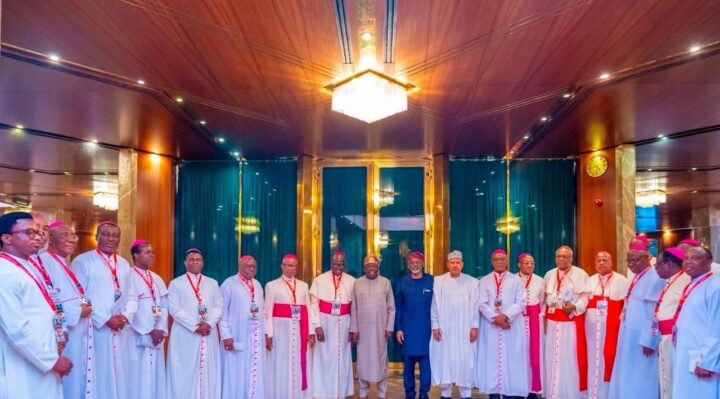
Speaking on Tuesday at the Presidential Villa in Abuja during a meeting with the leadership of the Catholic Bishops’ Conference of Nigeria (CBCN), President Tinubu said his administration is repositioning the country’s security architecture through institutional reforms, enhanced intelligence gathering and expanded military capacity.
The delegation, led by CBCN President and Archbishop of Kaduna, Most Rev. Matthew Ndagoso, included 19 senior Catholic bishops.
Tinubu: Security Reforms Underway
The President said the Federal Government is restructuring security operations to improve effectiveness in combating insurgency and other violent crimes across the country.
According to him, the reforms include better intelligence coordination, increased logistics support, improved welfare for frontline security personnel and expanded military infrastructure.
“I have just approved the expansion of the armed forces. We are acquiring more equipment and building new barracks. We will defeat terrorism,” Tinubu said.
He urged religious leaders to support the government’s efforts by promoting peace and condemning violence in their communities.
“We don’t have another country but Nigeria. In our diversity, we must continue to work together for peace, unity and national development,” he added.
President Says Economy Has Recovered
Tinubu also defended his administration’s economic reforms, saying Nigeria has moved away from the fiscal challenges it inherited and is now on a more stable economic path.
“The economy has recovered. The fears of bankruptcy and uncertainty that confronted the country when we assumed office have been overcome,” the President said.
“This government has stabilised the nation, and prosperity is on the horizon. Life is improving.”
He reiterated that his administration inherited both the assets and liabilities of previous governments but has implemented reforms aimed at restoring macroeconomic stability and rebuilding investor confidence.
Education and Poverty Reduction Remain Priorities
The President identified education as a key pillar of his administration’s poverty reduction strategy, highlighting initiatives such as the Nigerian Education Loan Fund (NELFUND), which provides financial support for students pursuing higher education.
Tinubu encouraged young Nigerians to take advantage of government programmes focused on education, entrepreneurship and skills development to improve their economic prospects.
He also noted improvements in the university system, pointing to the relative stability of academic calendars.
“You can now complete a four-year university programme in four years. The prolonged disruptions caused by strikes are no longer the norm,” he said.
The President added that the approval of additional universities would help expand access to higher education while supporting future planning for student loan funding.
Tinubu Defends Electoral Institutions
On Nigeria’s democratic process, Tinubu maintained that the Independent National Electoral Commission (INEC) has remained impartial.
He dismissed allegations of bias ahead of the 2027 general elections, insisting that all political parties have equal opportunities under the current electoral framework.
“INEC is neutral. It has never intimidated anyone. If some political opponents are complaining, perhaps they are confronting their own internal challenges,” he said.
Mission Schools Under State Governments
Responding to concerns raised by the Catholic bishops on the return of mission schools, Tinubu said the matter falls within the constitutional powers of state governments.
He recalled that during his tenure as Governor of Lagos State, his administration returned mission schools to their original owners.
Catholic Bishops Raise Concerns
Earlier, CBCN President Archbishop Matthew Ndagoso commended Tinubu for hosting Archbishop Paul Gallagher, the Vatican’s Secretary for Relations with States and International Organisations, during the recent celebration of 50 years of diplomatic relations between Nigeria and the Holy See.
The bishops, however, expressed concerns over persistent insecurity, poverty, access to quality tertiary education and the need to strengthen Nigeria’s democratic institutions.
They also urged the Federal Government to ensure credible and peaceful elections in 2027, promote equal treatment for all religious groups and consider the return of mission schools where appropriate.
“As someone who played a significant role in Nigeria’s struggle for democracy, your greatest legacy would be strengthening our democratic institutions,” Ndagoso told the President.
Government Seeks Broad Support for Reforms
The meeting underscored the government’s efforts to engage religious leaders as key stakeholders in promoting national unity, security and economic development.
Tinubu reaffirmed that achieving lasting peace, expanding educational opportunities and sustaining economic reforms require collaboration between government, faith-based organisations and citizens.
He said national unity remains essential to securing long-term prosperity and ensuring a more stable future for generations of Nigerians.
Top of Form