


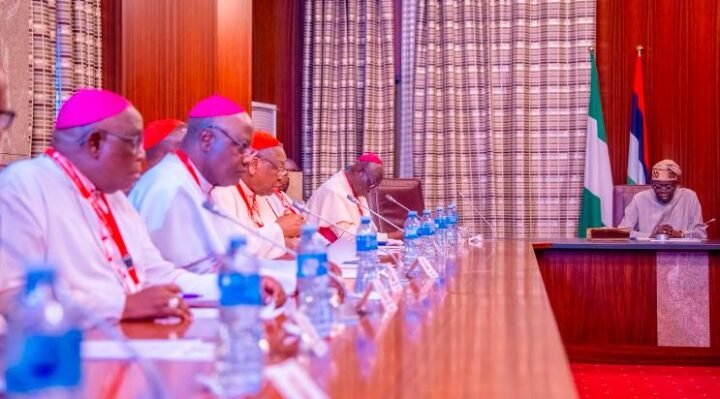


Nigeria’s Presidency has publicly challenged the Catholic Bishops’ Conference of Nigeria (CBCN) following remarks by Cardinal John Onaiyekan that disclosed details of a private meeting with President Bola Tinubu, deepening a public disagreement over the country’s economic conditions, security challenges and governance.
In separate statements issued on Saturday, presidential aides Temitope Ajayi and Daniel Bwala defended President Tinubu’s handling of the meeting, insisting that the bishops’ assessment of Nigeria reflected only one perspective and should not be regarded as the definitive account of the country’s situation.
The Presidency also faulted Cardinal Onaiyekan, Archbishop Emeritus of the Catholic Archdiocese of Abuja, for revealing discussions from the closed-door engagement, describing the disclosure as inappropriate and inconsistent with the confidentiality expected during high-level consultations.
Cardinal Onaiyekan Defends Bishops’ Position
The Presidency’s response followed an interview aired on ARISE Television in which Cardinal Onaiyekan discussed the July 28 meeting between President Tinubu and a delegation of the Catholic Bishops’ Conference at the Presidential Villa.
According to the cleric, the bishops raised concerns over worsening economic hardship, insecurity and Nigeria’s democratic trajectory, while the President maintained that his administration was making measurable progress.
Onaiyekan stressed that the memorandum presented to Tinubu represented the collective position of Nigeria’s Catholic bishops after extensive consultation and revision.
He said the conference had no political ambitions but considered it a moral responsibility to speak honestly about the realities confronting Nigerians.
The cardinal added that the bishops deliberately chose not to present what he described as an overly optimistic picture of the country, arguing that religious leaders have a duty to communicate the experiences of ordinary citizens.
According to him, President Tinubu disagreed with many of their observations, particularly their assessment that current economic policies were worsening hardship.
Onaiyekan said the delegation expected disagreements but believed it was important to present what they regarded as the realities facing Nigerians rather than offer flattering assessments.
He also suggested that the President appeared dissatisfied with the bishops’ observations, arguing that many advisers surrounding the President often presented a more positive picture of national conditions than what citizens experience daily.
Presidency Says Bishops’ Assessment Is Open to Challenge
Responding to the interview, Senior Special Assistant to the President on Media and Publicity, Temitope Ajayi, said the Catholic bishops were entitled to their views but insisted that their assessment was neither infallible nor beyond public scrutiny.
Ajayi noted that the bishops had requested the audience with President Tinubu and were allowed to express their concerns freely, after which the President responded with what he described as facts and evidence supporting his administration’s record.
According to him, while the bishops acknowledged the impact of the Nigerian Education Loan Fund (NELFUND), they largely overlooked other achievements of the administration.
He argued that improvements such as more regular salary and pension payments demonstrated that the government had made tangible progress despite ongoing economic challenges.
Ajayi further rejected the bishops’ characterisation of Nigeria as “bleeding,” saying the President has access to intelligence reports and operational briefings that provide a broader understanding of developments across the country.
He maintained that Tinubu had never denied the existence of security and economic challenges but had consistently argued that his administration had stabilised public finances and laid the foundation for economic recovery after inheriting severe fiscal difficulties.
Ajayi also dismissed suggestions that the President relied on a narrow circle of advisers detached from public realities.
According to him, Tinubu receives daily security and intelligence briefings, reads multiple national newspapers, monitors television reports and regularly consults a wide range of stakeholders.
He argued that while the Catholic Bishops’ Conference remains an important national institution, it is not the sole voice representing public opinion or the nation’s conscience.
Daniel Bwala Questions Cardinal’s Political Neutrality
Presidential spokesman Daniel Bwala also criticised Cardinal Onaiyekan, alleging that his intervention reflected political considerations.
Bwala argued that the Catholic Church had openly supported Labour Party presidential candidate Peter Obi during Nigeria’s 2023 presidential election and suggested that the cardinal’s comments should be viewed within that political context.
He defended President Tinubu’s decision to reject the bishops’ assessment of the economy, saying the administration’s position was supported by economic data, official statistics and measurable indicators.
Bwala also accused the cardinal of applying a double standard by encouraging religious adherents to profess optimism despite hardship while criticising the government’s positive assessment of the economy.
He further argued that Nigeria’s Christian community is represented by several organisations beyond the Catholic Bishops’ Conference, many of which, he said, have maintained political neutrality.
Bishop Matthew Kukah of the Roman Catholic Diocese of Sokoto, who was part of the delegation that met President Tinubu, declined to comment further on the controversy.
He said he could not publicly adopt a separate position after participating in the delegation.
Meanwhile, Lagos Central Senatorial candidate of the Nigeria Democratic Congress, Ladipo Johnson, criticised President Tinubu over comments suggesting that Nigerians facing economic hardship could seek assistance from churches.
Johnson described the President’s remarks as a troubling moment in presidential communication, arguing that government should prioritise addressing the underlying causes of economic hardship rather than directing struggling citizens to religious institutions.
The exchange between the Presidency and the Catholic Bishops highlights the increasingly public debate over Nigeria’s economic reforms, inflation, security challenges and the social impact of government policies.
While the Tinubu administration maintains that key reforms have restored fiscal stability and placed the economy on a recovery path, critics—including influential religious leaders—continue to argue that many Nigerians have yet to experience meaningful improvements in their living conditions.
The latest disagreement underscores the tension between government efforts to defend ongoing reforms and growing calls from civil society and religious institutions for more urgent measures to alleviate economic hardship.