


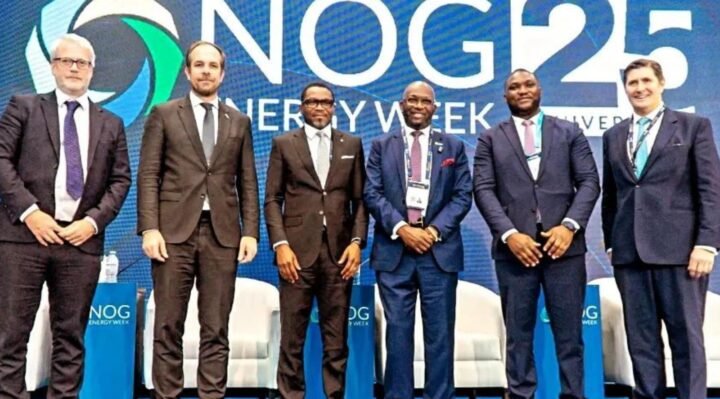


David Parkinson, VP Consulting, Wood Mackenzie; Matthieu Bouyer, Country Chairman/Managing Director, TotalEnergies Nigeria; Joseph Alagoa, General Manager, Technical, NLNG; Tony Attah, Managing Director/CEO, Renaissance Africa Energy; Josh Egba, West Africa Representative, U.S. Trade and Development Agency; and Roger Brown, Managing Director/CEO, Seplat Energy, on Tuesday during Day One of the Strategic Conference on the sidelines of NOG Energy Week 2026, ongoing in Abuja.
NOG Energy Week 2026 marked a significant shift in Nigeria’s energy dialogue, with policymakers, investors and industry leaders moving beyond policy discussions to focus on project execution, investment mobilisation and gas-led industrialisation.
Celebrating its 25th anniversary, the conference brought together government officials, international oil companies (IOCs), national oil companies (NOCs), indigenous energy firms, financial institutions, technology providers and development partners to define the next phase of Nigeria’s energy transition and Africa’s broader energy ambitions.
Unlike previous editions that largely centred on policy debates, this year’s conference was characterised by a strong emphasis on converting reforms into commercially viable projects capable of attracting long-term capital.
A Shift from Policy to Projects
The dominant theme throughout the conference was the transition from “policy to projects.”
Organisers positioned the event as a platform where government policies, private capital and industry capabilities converge to accelerate investment across Nigeria’s oil, gas and liquefied natural gas (LNG) value chain.
The conference focused on three strategic objectives:
- Accelerating investment in Nigeria’s and Africa’s oil, gas and LNG infrastructure.
- Translating energy reforms into bankable projects across eight strategic pillars.
- Positioning Nigeria as a regional hub for oil, gas and LNG supply amid changing global energy markets and supply chain realignments.
The message from industry leaders was consistent: policy reforms alone are no longer enough. Success will increasingly be measured by projects that reach financial close, attract investment and enter construction.
Upstream Growth Remains Central
Nigeria’s ambition to increase crude oil production remained a major talking point.
Government officials reiterated the country’s target of producing 2.5 million barrels per day (bpd), driven by increased investment in deepwater projects, reactivation of dormant fields and the continued implementation of the Petroleum Industry Act (PIA).
Conference participants pointed to recent production improvements as evidence that reforms are beginning to yield results. Industry data presented during the event showed production rising from approximately 1.46 million bpd in October 2024 to nearly 1.8 million bpd by mid-2025, while crude production in May 2026 stood at about 1.53 million bpd.
However, several speakers cautioned that sustaining higher production will depend on faster project approvals, improved security, expanded infrastructure and continued investor confidence.
Gas Emerges as the Centrepiece
If one sector dominated NOG 2026, it was natural gas.
Virtually every major session highlighted gas as the cornerstone of Nigeria’s industrialisation strategy and a key driver of export-led economic growth.
The Nigerian National Petroleum Company (NNPC) Limited’s Gas Master Plan 2026 featured prominently, with discussions shifting from strategic planning to implementation.
Key priorities included expanding gas-to-power infrastructure, increasing domestic LPG utilisation, developing industrial feedstock and unlocking additional LNG export opportunities.
The African Atlantic Gas Pipeline also received renewed attention, with stakeholders describing the project as a strategic initiative capable of strengthening regional energy integration while expanding gas markets across West Africa and beyond.
Infrastructure and Integrated Energy Systems
Another recurring theme was the need for integrated development across Nigeria’s upstream, midstream and downstream sectors.
Speakers argued that increasing crude production alone would not resolve Nigeria’s energy challenges unless supported by investments in pipelines, gas processing facilities, storage infrastructure, transportation networks and refining capacity.
The conference promoted an integrated energy systems approach designed to improve supply reliability, reduce infrastructure bottlenecks and enhance long-term energy security.
Financing Moves to the Forefront
Financing emerged as one of the conference’s most important discussions.
Industry executives stressed that attracting capital will require stronger risk-sharing mechanisms, regulatory certainty and commercially attractive project structures.
Rather than focusing solely on policy announcements, many sessions examined how to structure projects that meet international financing standards.
The participation of institutions including the World Bank, African Development Bank (AfDB) and Africa Finance Corporation underscored growing international interest in financing Nigeria’s energy infrastructure, particularly gas-related investments.
Stakeholders repeatedly emphasised that the next phase of growth will depend on converting investment commitments into projects that achieve financial close.
Technology and Artificial Intelligence Gain Momentum
Technology also featured prominently at the conference.
Sessions explored how artificial intelligence, digital technologies and advanced analytics can improve exploration success, optimise production, enhance operational efficiency and strengthen decision-making across the energy value chain.
Industry participants increasingly viewed digital transformation as an essential component of improving competitiveness while lowering operating costs.
Local Content Takes Centre Stage
One of the most significant discussions at NOG 2026 focused on Nigerian content development.
While delegates acknowledged the considerable progress made since the enactment of the Nigerian Oil and Gas Industry Content Development (NOGICD) Act, discussions increasingly centred on how indigenous companies can secure larger roles in high-value projects.
Participants highlighted the Nigerian Content Development and Monitoring Board’s (NCDMB) 10-Year Strategic Roadmap, which has been credited with creating more than 50,000 jobs while strengthening indigenous technical capacity and enterprise development.
Attention also focused on the Presidential Directive on Local Content, with industry stakeholders discussing stronger enforcement of existing regulations and their implications for investment decisions.
Gas value chains—including fabrication, LPG infrastructure and gas-to-power projects—were widely identified as the next major growth opportunity for Nigerian companies.
Persistent Challenges Remain
Despite optimism surrounding local content development, participants acknowledged several unresolved challenges.
Access to financing remains a major constraint for indigenous firms seeking to participate in large engineering, procurement and construction (EPC) contracts.
Questions were also raised about whether local companies possess sufficient manufacturing capacity and technical capability to execute increasingly complex projects rather than remaining largely service providers.
Execution remains another critical concern.
While government policies continue to evolve, stakeholders noted that bureaucratic delays, lengthy approval processes and slow project implementation could undermine Nigeria’s investment ambitions.
Exhibition Floor Reflects Industry Priorities
Running alongside the conference, the exhibition served as the commercial hub of NOG Energy Week.
Rather than simply showcasing products and services, exhibitors focused on partnership opportunities, technology demonstrations and project collaborations.
Gas infrastructure developers, engineering firms, digital technology providers and local service companies dominated exhibition activities, reflecting the conference’s emphasis on investment and project execution.
For many participants, the exhibition represented where policy discussions translated into commercial opportunities through business meetings, memoranda of understanding and strategic partnerships.
Key Takeaways
NOG Energy Week 2026 distinguished itself through its sharper focus on execution, investment mobilisation and measurable project outcomes.
The conference also expanded its regional outlook, with initiatives such as the African Atlantic Gas Pipeline reinforcing Nigeria’s ambition to become a major regional energy hub.
For journalists, investors and business observers, the extensive use of production data, investment projections and implementation roadmaps provided tangible indicators of industry direction rather than broad policy statements.
Where Stakeholders Want More Progress
Despite the conference’s positive outlook, participants identified several areas requiring greater attention.
Few major final investment decisions (FIDs) were announced during the event, leading some observers to question how quickly announced projects would progress.
Stakeholders also noted limited discussion around host community development, emissions reduction and broader energy transition issues beyond positioning natural gas as a transition fuel.
With Nigeria maintaining an ambitious production target, many delegates stressed that reforms must now deliver measurable results at a faster pace.
Outlook
NOG Energy Week 2026 reinforced Nigeria’s determination to position natural gas as the engine of industrial growth while strengthening investment across the country’s oil and gas sector.
More importantly, the conference signalled a broader shift in industry expectations. Investors, policymakers and operators are increasingly demanding tangible project execution rather than additional policy declarations.
The central question emerging from the event is no longer whether Nigeria has the right policies, but whether government and industry can deliver the financing, infrastructure and execution needed to transform those policies into commercially successful projects.
For Nigeria’s local content agenda, the challenge is equally clear: after 25 years of progress, the next test will be whether indigenous companies can secure and execute multi-billion-dollar gas and energy infrastructure projects that define the country’s next phase of growth.