


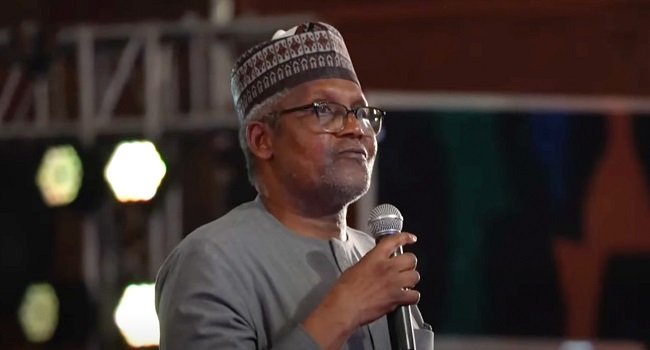


NEW YORK — Africa must accelerate industrialisation, retain more of its capital and process its natural resources locally if the continent is to convert its vast resource base into sustained economic growth, jobs and wealth, Aliko Dangote has said.
Speaking at the Global Africa Business Initiative’s Unstoppable Africa 2026 gathering in New York on the sidelines of the 81st United Nations General Assembly, the President and Chief Executive of Dangote Industries Limited said Africa’s development strategy must shift from exporting raw materials to building globally competitive industries at scale.
Dangote pointed to the 700,000-barrel-per-day Dangote Petroleum Refinery as an example of the industrial capacity that African businesses can develop when capital, ambition and execution are combined.
“For years, we have continued to talk about our potential, our resources, our markets and our opportunities, but now we must move beyond talking about potential to building the industries and systems that will turn that potential into real economic development,” he said.
He argued that Africa’s challenge was not a lack of resources or investment opportunities, but the continent’s ability to mobilise capital and develop projects large enough to transform its economies.
Dangote: Africa must keep its capital
Dangote said African investors should deploy more of their capital within the continent rather than strengthening financial institutions outside Africa.
He cited Asia’s economic transformation as an example, arguing that businesses and investors in the region played a major role in building domestic industries by backing their own economies.
“The Asians believed in their own economy. So they are the ones that made their own economy,” Dangote said.
Africa, he said, had often followed a different path by moving domestic savings offshore.
“We are doing it the reverse, where we take our own money to their banks, strengthen their banks, and we don’t really keep our money in our own continent,” he said.
For Dangote, greater domestic investment would help Africa build the manufacturing, processing and infrastructure capacity needed to create higher-value economic activity.
Refinery IPO aims to broaden African ownership
Dangote also linked industrialisation to ownership, saying Africans should have opportunities to own stakes in major industrial assets developed on the continent.
He cited the decision to list Dangote Petroleum Refinery and Petrochemicals on the Nigerian Exchange as part of that strategy.
“Yes, we must list it on the shores of Africa to make it an African company. We are listing it in Nigeria because we want Africans to have the opportunity to participate in the ownership of this major African industrial asset and to ensure that the value created by the refinery is anchored within the continent,” he said.
Dangote said the refinery’s public offering had generated strong investor interest, with the digital infrastructure supporting subscriptions temporarily overwhelmed by the volume of applications.
He said interest had also come from outside Nigeria and that the Group intended to broaden participation and give smaller investors greater access to the company’s equity.
The refinery IPO is therefore being positioned not only as a capital-market transaction but also as a mechanism for widening African ownership of a strategic industrial asset.
$46bn-$50bn Vision 2030 investment plan
Dangote said the Group’s Vision 2030 programme involves planned investments of between $46 billion and $50 billion across major industrial projects.
A central component is the planned expansion of the Dangote refinery from its current 700,000 barrels per day capacity to 1.4 million barrels per day.
The investment programme also covers expansion in petrochemicals and other industrial businesses as the Group seeks to deepen its manufacturing footprint.
The planned expansion would further strengthen the refinery’s role in Nigeria’s downstream petroleum market and potentially increase the availability of locally refined petroleum products for domestic and regional markets.
$16bn Lamu refinery project
Dangote also disclosed plans for a major refinery project in Lamu, Kenya, as part of the Group’s wider African expansion.
He said the project was expected to be launched on September 30 and would involve an estimated $16 billion investment, with completion targeted within three years.
“We’re actually launching that project on the 30th of this month and spending $16 billion on that project and it will be ready within the next three years,” he said.
The proposed Lamu investment would extend Dangote’s industrial strategy beyond Nigeria and deepen its focus on developing large-scale processing capacity close to African markets.
Such projects, Dangote argued, could reduce dependence on imported finished products while creating opportunities for local manufacturing, employment and supply-chain development.
Africa needs projects with scale
Dangote said international investors were increasingly interested in Africa but were looking for projects with sufficient scale and credible sponsors capable of executing them.
“A lot of people want to invest in Africa, but they are looking for scale and also who is doing that investment,” he said.
He said the challenge was increasingly about connecting available global capital with viable African projects.
“They are ready. People are ready. They are willing. They want to invest money in the continent, but they don’t know how and where,” he said.
That gap, he suggested, creates an opportunity for African businesses to develop investable projects capable of attracting international capital while retaining a greater share of the economic value within the continent.
Refinery demonstrates African execution capacity
Reflecting on the development of the Dangote refinery, Dangote described the project as the most challenging undertaking of his business career.
He said the refinery demonstrated that African entrepreneurs could execute projects at a scale previously considered difficult to achieve on the continent.
“The refinery we’re talking about has never been built before in the world, not in Africa, by anybody,” Dangote said, referring to its scale.
He said the project reinforced his belief that African businesses should not allow existing infrastructure and financing constraints to determine the limits of their ambitions.
“We have escaped the bar. They’ve set up a bar for us not to go across, but we have escaped. We’re on the other side now,” he said.