


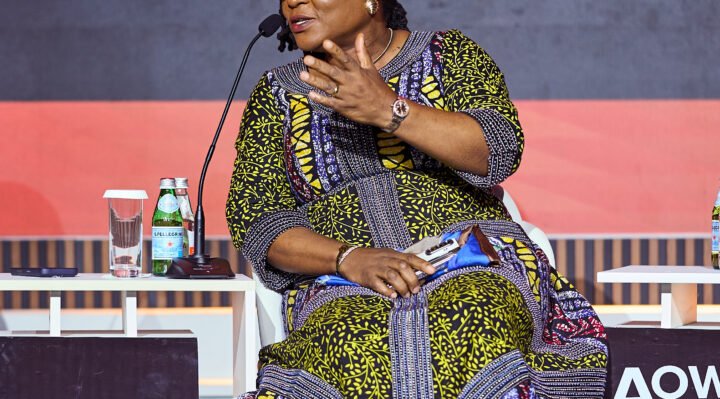


West Africa Exploration and Production Company (WAEP), the upstream arm of Dangote Group, is targeting a major production ramp-up over the next 24 months as it moves to unlock more than 1.6 billion barrels of oil in place and about 1.9 trillion cubic feet of gas across its Nigerian assets.
The company is pursuing a phased development strategy focused on restoring production from its brownfield assets, generating early cash flow and reinvesting the proceeds in drilling, field redevelopment and gas monetisation.
WAEP Managing Director and Chief Executive Officer, Olajumoke Cecilia Ajayi, disclosed the strategy at the AOW Energy Conference in Accra, Ghana, where she participated in a session titled “The Future of the African Operator: Building the IOCs of Tomorrow.”
Ajayi said the company’s Oil Mining Leases (OMLs) 71 and 72, formerly operated by Shell, offered significant upstream potential, with discoveries to date indicating more than 1.6 billion barrels of oil in place and approximately 1.9 trillion cubic feet of gas.
She said WAEP’s immediate focus was on extracting value from existing opportunities before committing to larger-scale redevelopment.
“The first thing is to look at the low-hanging fruit, the short-term oil gains, generate cash flow from that, put it back into the assets and start redevelopment. And that’s exactly what is happening currently,” Ajayi said.
WAEP to deploy three jack-up rigs
The production strategy is already moving into execution, with WAEP having signed contracts for three jack-up rigs for its upcoming drilling campaign.
According to Ajayi, drilling is expected to commence in December as the company seeks to increase output from the OML 71 and OML 72 portfolio and unlock additional value from the assets.
“We will be drilling to ramp up production and also bring out the value in the asset,” she said.
The drilling programme is being supported by six field development plan studies currently underway. Ajayi said the studies would establish the technical and commercial foundation for a sequence of developments across the assets.
The approach is designed to create a continuous pipeline of drilling and development activity rather than relying on isolated projects, supporting more consistent production growth and improving the economics of the brownfield portfolio.
Dangote refinery provides potential domestic crude market
WAEP’s upstream expansion is also closely linked to Nigeria’s drive to deepen domestic crude processing.
Ajayi identified Dangote Petroleum Refinery and Petrochemicals as a potential market for crude produced from the company’s assets, given the refinery’s ownership structure and its requirement for reliable crude supplies.
“One of the shareholders, one of the partners on this asset, is the owner of the largest refinery in Africa, Dangote Petroleum Refinery and Petrochemicals. So the oil would definitely be needed by the refinery,” she said.
The potential relationship could strengthen the integration between Nigeria’s upstream and downstream petroleum sectors, allowing more domestically produced crude to be processed within the country rather than exported as raw material.
For WAEP, securing a reliable domestic market could also improve crude evacuation economics and provide greater certainty as production increases.
WAEP plans crude evacuation terminal
As part of its broader infrastructure strategy, WAEP is also working towards establishing a dedicated crude oil evacuation terminal.
Ajayi said the proposed facility could potentially serve WAEP’s own production as well as other producers seeking to aggregate and evacuate crude.
Such infrastructure could create an additional commercial opportunity for the company while helping address one of the persistent constraints facing Nigerian upstream operators: reliable and cost-effective crude evacuation.
Improving evacuation capacity is particularly important for brownfield developments, where production can be constrained not only by reservoir performance but also by pipeline availability, infrastructure reliability and security challenges.
Building African upstream operators at scale
Ajayi said the long-term success of African independent exploration and production companies would depend on their ability to convert asset ownership into sustained production, cash generation and reinvestment.
She noted that taking over mature assets from international oil companies involved considerably more than acquiring reserves and licences. Operators must also build technical capabilities, deploy capital efficiently, maintain operational discipline and develop the organisational capacity required to manage complex assets.
“We need to put round pegs in round holes. We need to put the right skill and competence in the different units,” Ajayi said.
She added that WAEP had been deliberate in strengthening its technical and organisational capabilities ahead of the next phase of development.
Gas monetisation central to WAEP’s strategy
While increasing oil production remains an immediate priority, WAEP is also positioning gas monetisation as a key component of its 24-month development plan.
Ajayi said the company’s objective was not simply to increase production temporarily but to establish a more reliable and sustainable production system while putting the necessary infrastructure and commercial arrangements in place to monetise its gas resources.
“Between now and the next 24 months, gas monetisation would have been in place. We would have ramped up production consistently,” she said.
“Not produce today, tomorrow you are down. Consistent, sustained production.”
The strategy reflects the growing importance of gas to Nigeria’s energy and industrial ambitions, as the country seeks to reduce gas flaring, expand domestic gas supply and develop new revenue streams from its substantial gas resources.
For WAEP, successful execution of the programme could transform OML 71 and OML 72 from mature brownfield assets into a more productive and commercially integrated upstream portfolio, combining oil production, gas monetisation and shared infrastructure.
Ajayi also participated in a separate conference session, “The Nigerian Upstream Opportunity: Unpacking Nigeria’s Basins,” which examined the investment and development potential across the country’s petroleum basins.
The discussions come as Nigeria seeks to increase crude production, attract fresh upstream investment and strengthen the capacity of indigenous and African-owned operators to take a larger role in the continent’s oil an