


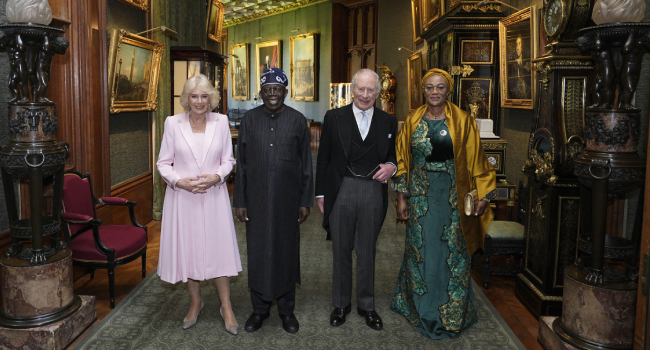


Britain’s King Charles III and Nigeria’s President Bola Tinubu stand with their wives Britain’s Queen Camilla (L) and Nigeria’s First Lady Oluremi Tinubu as they pose for a photograph in the Grand Corridor, during an audience at Windsor Castle, in Windsor, on March 18, 2026, on the first day of a two-day State Visit to the United Kingdom by Nigeria’s President. (Photo by Aaron Chown / POOL / AFP)
President Bola Tinubu has urged the United Kingdom to deepen its support for Nigeria’s counterterrorism efforts, stressing that stronger bilateral cooperation is vital to safeguarding security and stability across West Africa.
Speaking at a state banquet hosted at Windsor Castle, Tinubu underscored the enduring historical ties between Nigeria and the UK, describing their shared institutions, culture, and values as a solid foundation for enhanced collaboration in security, trade, and governance.
Addressing distinguished guests including King Charles III, Queen Camilla, Prince William, and Catherine, Princess of Wales, Tinubu described the occasion as historic, noting he was the first Nigerian leader to speak at the iconic royal residence.
Focusing on regional security, the president highlighted the growing threat of terrorism across the Sahel and West Africa, noting Nigeria’s central role in maintaining regional stability. He said closer cooperation with the UK—particularly in intelligence sharing, military training, and coordinated counterterrorism operations—remains essential.
Tinubu also revealed plans to meet UK Prime Minister Keir Starmer to advance discussions on security collaboration, trade expansion, and investment opportunities.
Reflecting on Nigeria’s governance framework, Tinubu traced its roots to British influence, citing the adoption of common law, parliamentary traditions, and civil service structures. He said these foundations have helped Nigeria build a resilient democratic system adapted to local realities.
The president praised the Nigerian diaspora in the UK for their contributions across sectors, particularly healthcare, education, business, and sports. He highlighted prominent figures of Nigerian descent, including footballers Bukayo Saka and Eberechi Eze, rugby star Maro Itoje, and boxing champion Anthony Joshua, as symbols of enduring ties between both nations.
Tinubu further emphasised Nigeria’s economic potential, pointing to its youthful population and growing entrepreneurial base, while noting ongoing collaboration with the UK in agriculture, technology, and the creative industries. He added that engagement through the Commonwealth of Nations provides an additional platform for strengthening trade, education, and governance links.
He also reflected on Nigeria’s pro-democracy struggle in the 1990s, expressing gratitude for the refuge and protection he and other activists received in the UK during military rule.
Despite ongoing challenges, Tinubu expressed optimism about Nigeria’s future, describing the country as being on the cusp of a renaissance driven by innovation, resilience, and human capital.
King Charles Praises Nigeria’s Religious Harmony, Economic Influence
In his remarks, King Charles III commended Nigeria as a model of religious coexistence, noting that people of different faiths have continued to live together in peace and shared purpose.
The monarch reaffirmed the UK’s commitment to supporting Nigeria in addressing security challenges, including strengthening rapid response capabilities and humanitarian interventions in northern regions.
He described Nigeria as an economic powerhouse and a major diplomatic voice in Africa, highlighting expanding trade and investment ties between both countries. According to him, Nigerian businesses are increasingly active in the UK, with several firms listed on the London Stock Exchange, while UK-backed financing continues to support infrastructure development in Nigeria.
King Charles also acknowledged the complexities of the two nations’ shared history, noting that while past injustices cannot be erased, they provide lessons for building a more cooperative and forward-looking partnership.
He concluded by emphasising the importance of the Commonwealth alliance in fostering global collaboration, describing UK–Nigeria relations as a “partnership of equals” anchored on mutual respect, shared prosperity, and a hopeful future.