


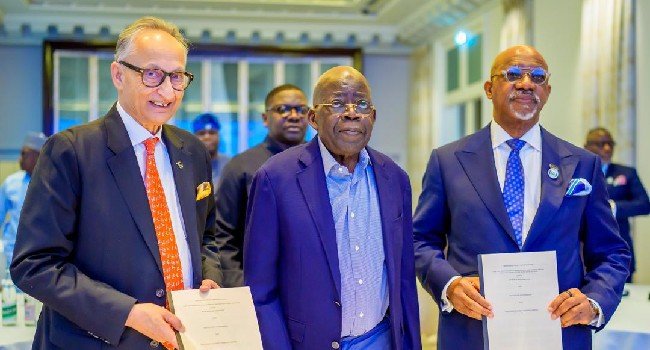


PARIS — President Bola Ahmed Tinubu has assured domestic and international investors of regulatory clarity, policy stability and a predictable business environment as Nigeria seeks to attract long-term capital into critical infrastructure and industrial development.
Tinubu gave the assurance in Paris, France, at the signing of Memoranda of Understanding between the Ogun State Government and global ports and logistics operator DP World for the development of the Gateway Deep Sea Port and the Ogun State Blue Marine Special Economic Zone (SEZ).
The projects are expected to attract more than $7 billion in initial investment and create over 50,000 direct jobs, according to the Ogun State Government.
The President witnessed the signing alongside the Minister of Marine and Blue Economy, Adegboyega Oyetola, and the Director-General of the Nigerian Ports Authority, Abubakar Dantsoho.
The agreements between Ogun State and DP World MEA FZE bring together federal and state authorities, private-sector investors and financial advisers in a framework designed to address Nigeria’s persistent logistics constraints and expand manufacturing and export capacity.
Tinubu said the projects represented more than an infrastructure investment, describing them as a platform for integrating maritime transport, industrial production, logistics and international trade.
“We are doing more than signing agreements; we are laying the foundation for a new chapter in Nigeria’s development,” the President said.
Ogun port targets larger vessels, lower logistics costs
The proposed Gateway Deep Sea Port at Ogun Waterside will have a four-kilometre berth and an 18-metre draft, allowing it to accommodate larger vessels and potentially reduce pressure on the Lagos port corridor.
The port is planned to operate alongside the proposed 10,000-hectare Blue Marine Special Economic Zone, creating an integrated maritime and industrial hub for manufacturing, processing and export-oriented businesses.
Tinubu said the combination of port infrastructure and industrial capacity could help Nigeria capture more value from its raw materials and strengthen its non-oil export base.
“A port moves cargo; a port integrated with a special economic zone helps to build an economy,” he said.
The project is expected to enable businesses to process imported inputs into finished products while creating capacity to convert Nigerian raw materials into exportable goods.
For manufacturers and exporters, the development could provide an alternative logistics corridor while improving access to regional and international markets.
Lagos-Calabar highway to provide critical link
Tinubu also identified the 28-kilometre Ogun section of the Lagos-Calabar Coastal Highway as a critical piece of infrastructure for connecting the proposed port and industrial zone with Lagos, Nigeria’s hinterland and wider African markets.
The emerging corridor is also expected to connect with other strategic projects, including the proposed Nigerian Navy Operating Base and Dockyard and the OK LNG Project.
The Federal Government sees the combination of maritime infrastructure, industrial capacity, energy and transport connectivity as part of a broader strategy to strengthen Nigeria’s position as a regional trade and manufacturing hub.
Tinubu said the more than $7 billion investment package and projected employment creation represented a practical expression of the administration’s economic diversification and industrialisation agenda.
He commended Ogun State Governor Dapo Abiodun for securing the land and developing an investment framework designed to reduce project risks.
The President described the project as an example of cooperative federalism, with state-level initiatives receiving federal backing.
He also pledged federal support for road, rail and power infrastructure, investment protection and the wider maritime environment.
Tinubu said the government would hold the parties to their commitments, stressing that the agreements must translate into actual investments, infrastructure, jobs and economic opportunities.
Abiodun: Port will connect Ogun to global markets
Governor Abiodun described the agreements as a significant milestone in Ogun State’s efforts to develop its coastline and deepen its integration into global trade.
According to a statement by the governor’s Special Adviser on Information and Strategy, Kayode Akinmade, Abiodun said the deep-seaport project had remained largely unrealised for more than three decades before the latest push.
The governor credited Tinubu’s leadership with helping move the project from a long-standing ambition towards implementation.
He also commended the Federal Ministry of Marine and Blue Economy, the NPA and other federal institutions for supporting the development.
Abiodun said the deep seaport was designed not simply as a maritime facility but as part of a wider economic corridor covering logistics, manufacturing, technology, SMEs and exports.
“Our ambition is not merely to berth ships. We are building a gateway for Ogun and Nigeria’s productive strength to reach Africa and the world,” he said.
He said the project could stimulate supply chains, attract foreign direct investment and create opportunities across maritime services, logistics, manufacturing and technology.
The governor also pointed to DP World’s Jebel Ali Free Zone model in the United Arab Emirates as an example of how ports and special economic zones can be integrated to support industrial activity and international trade.
Multimodal infrastructure to underpin investment
The Ogun project is expected to form part of a broader multimodal infrastructure network linking the deep seaport with the Gateway International Airport, dry ports, the Lagos-Calabar Coastal Highway and industrial clusters.
For investors, the economic proposition will depend heavily on whether these complementary infrastructure projects are delivered alongside the port and SEZ.
Abiodun acknowledged the importance of implementation, saying the ultimate test would not be the signing of agreements but the delivery of infrastructure and economic value.
“History will judge us not by the elegance of documents signed, but by the transformation that follows. Ceremonies proclaim intentions; only implementation creates prosperity,” he said.
The governor also pledged Ogun State’s commitment to host-community participation, environmental sustainability and security.
The agreements mark a significant step in Ogun’s long-running effort to develop its coastline and establish a major maritime-industrial corridor linking the state to Nigeria’s domestic market and international trade routes.
For Nigeria, the larger strategic question is whether the proposed $7 billion investment can move from MoUs to bankable projects, construction and commercial operations — and whether the port-SEZ model can materially lower logistics costs while expanding the country’s manufacturing and export base.