


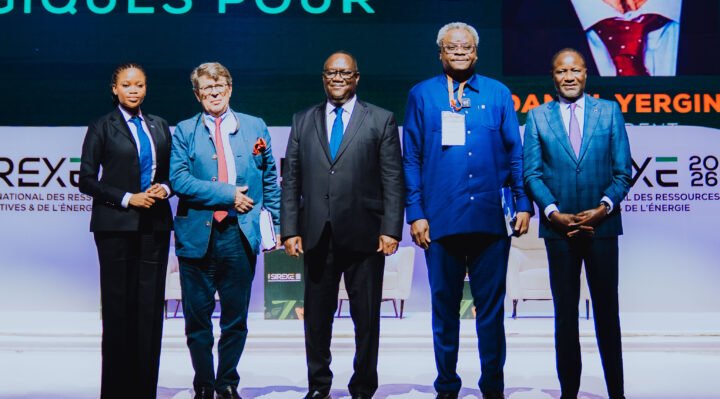


Photo caption: From left: Bogolo Joy Kenewendo, Minister of Minerals and Energy, Botswana; Philippe Chalmin, French economist and commodity market specialist; Téné Birahima Ouattara, Vice Prime Minister; Kola Adesina, Group Managing Director, Sahara Power Enterprise Group; and Mamadou Sangafowa-Coulibaly, Minister of Mines, Petroleum and Energy, Côte d’Ivoire, at SIREXE 2026 in Abidjan.
Sahara Group has called for increased African-led investment in energy infrastructure, highlighting its partnership with Côte d’Ivoire’s PETROCI as a model for strengthening energy security, expanding local capacity and driving sustainable economic growth across the continent.
Speaking at the 2026 Salon International des Ressources Extractives et de l’Énergie (SIREXE) in Abidjan, Kola Adesina, Group Managing Director, Sahara Power Enterprise Group, said Africa must prioritise infrastructure development, indigenous investment and strategic partnerships to unlock the economic value of its energy resources. Adesina spoke during a session on Geopolitics and International Oil and Gas Logistics: Strategic Implications from Africa, where he stressed the need for African countries to move beyond exporting raw resources towards developing domestic processing, transportation, storage and distribution capacity.
“Having natural resources is an advantage, but the real value lies in what we build around them. Africa must move beyond exporting raw materials and importing finished products. We need to develop the capacity to process, distribute and use our resources to power industries, create jobs, and compete in global markets,” he said.
He cited Sahara’s partnership with PETROCI as an example of how African companies can mobilise capital, technical expertise and local market knowledge to address infrastructure gaps and improve energy supply. At the centre of the collaboration is SAPET GAS, an 11,500-tonne liquefied petroleum gas (LPG) carrier deployed to strengthen the transportation and security of butane supplies into Côte d’Ivoire, alongside investments in LPG storage infrastructure in Abidjan.
Through SAPET Energy, Sahara and PETROCI are also advancing a 12,000-metric-tonne LPG storage facility, with plans for further expansion. The infrastructure is helping reduce demurrage costs associated with LPG supply logistics, improve operational efficiency and strengthen access to cleaner cooking energy for households and businesses in Côte d’Ivoire.
“The SAPET GAS partnership is a practical example of what value addition looks like. It brings together local market knowledge, national priorities, investment and operating capability to address a real energy need. The value is not simply in owning an asset; it is in what that asset makes possible for the market and the people it serves,” Adesina said.
He said African-led partnerships could help retain more economic value within the continent while delivering energy infrastructure tailored to local market requirements. Sahara expands LPG infrastructure across Africa Sahara Group is extending its LPG infrastructure investment strategy beyond Côte d’Ivoire as it seeks to expand its footprint across African energy markets.
In Ghana, the company has commissioned an LPG storage facility and deployed MT Asharami Ghana as a dedicated vessel to support LPG supply and distribution.
In Kenya, Sahara recently broke ground on a 30,000-metric-tonne LPG storage terminal, expanding its investments into East Africa. These projects complement the company’s growing LPG shipping capacity through WAGL Energy, its joint venture with NNPC Limited, strengthening an integrated network covering maritime transportation, storage, supply and distribution across African markets.
Adesina said Africa’s energy transition presents an opportunity to build stronger indigenous businesses, develop local supply chains and attract the investment and technical expertise required to close infrastructure gaps and expand energy access.
For Sahara, the strategy aligns with its Beyond XXX proposition, building on three decades of operating experience to pursue a new phase of growth, innovation and impact. He said the company would continue working with PETROCI and other partners to develop energy infrastructure capable of strengthening energy security, improving supply reliability and expanding access to cleaner energy across Africa.