


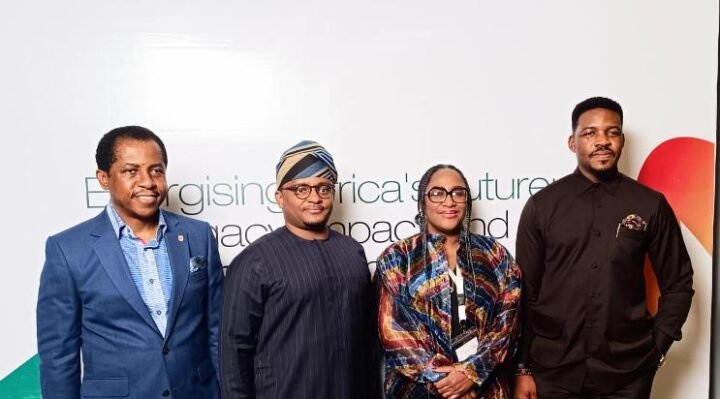


L-R: Bethel Obioma, Head, Corporate Communications, Sahara Group; Sadiq Wanka, Special Assistant to the President on Power Infrastructure; Ejiro Gray, Director, Governance and Sustainability, Sahara Group; and Nomnso Dike, CEO, Asharami Synergy (a Sahara Downstream Company) at the third edition of Asharami Square, a Sahara Group thought leadership initiative aimed at promoting sustainability through effective media advocacy
Sahara Group has called for a fundamental rethink of Africa’s approach to energy transition, infrastructure financing and energy journalism, urging governments, investors, policymakers and the media to adopt solutions tailored to the continent’s development priorities while strengthening partnerships that can drive sustainable growth.
The call was made at the third edition of Asharami Square, Sahara Group’s thought leadership platform, held under the theme “Energising Africa’s Future: Legacy, Impact and Transformation.” The event brought together government officials, energy experts, financial institutions, regulators, academics and journalists to examine the future of Africa’s energy landscape and the investment frameworks required to support it.
Opening the event, Sahara Group’s Director of Governance and Sustainability, Ejiro Gray, said the company’s Beyond XXX vision is focused on shaping Africa’s future rather than celebrating past achievements.
Gray stressed that Africa’s energy transition should be guided by local realities, economic priorities and inclusive development objectives. She also challenged journalists to provide balanced, evidence-driven reporting that captures the complexities of energy policy, sustainability and economic transformation.
“Effective journalism should not only tell us what happened; it should help us understand why it matters, whose interests are affected and what perspectives are missing from the conversation,” she said.
Nigeria’s Power Sector Offers New Investment Opportunities
Delivering the keynote address, Sadiq Wanka, Special Adviser to the President on Power Infrastructure, said ongoing reforms in Nigeria’s electricity sector are opening new opportunities for domestic and international investors.
According to Wanka, the primary challenge facing Africa’s energy sector is no longer technology but the ability to mobilise long-term capital and develop investment-ready projects.
“The issue is no longer technology. The real challenge is mobilising capital at scale, structuring bankable opportunities and creating an ecosystem that attracts long-term financing,” he said.
He identified investment prospects across embedded generation, renewable energy, mini-grids, transmission infrastructure and industrial power solutions, while encouraging journalists to provide deeper analysis of policy implementation and investment outcomes.
Governance Key to Unlocking Infrastructure Capital
A high-level panel discussion examined the question: “Who is Financing Africa’s Energy Future?”
The session featured Prof. Abigail Ogwezzy-Ndisika, Director of the Institute of Continuing Education at the University of Lagos; Temitope George, Chief Executive Officer of the Lagos State Electricity Regulatory Commission (LASERC); Kemi Awodein, Managing Director, Investment Banking at Chapel Hill Denham; and was moderated by Adebiyi Olusolape, Associate Editor (Africa) at Argus Media.
Panelists agreed that Africa has substantial domestic and international capital available for infrastructure development but noted that attracting investment depends on improving governance, enhancing investor confidence and developing well-prepared, commercially viable projects.
Prof. Ogwezzy-Ndisika urged journalists covering the energy sector to move beyond reporting official announcements and instead focus on accountability and the real-world impact of policy decisions.
“Energy reporting must go beyond headline events and announcements. Journalists need to ask deeper questions, examine the evidence and connect policy decisions to their impact on communities and everyday lives,” she said.
George emphasised that investors are more likely to finance projects that are thoroughly prepared and commercially structured, while Awodein highlighted governance and transparency as critical drivers of infrastructure investment.
“Nigeria has demonstrated that domestic capital can finance transformational infrastructure at scale. The real differentiator is governance, transparency and a clear pathway to value creation,” Awodein said.
Sahara Group Launches Energy Reporting Fellowship
A key highlight of the event was the unveiling of the Asharami Square Energy Reporting Fellowship Judging Panel, reinforcing Sahara Group’s commitment to strengthening the quality of energy journalism across Africa.
Speaking on the initiative, Bethel Obioma, Head of Corporate Communications at Sahara Group, said the fellowship aims to equip journalists with deeper knowledge of the technical, commercial, environmental and policy dimensions of the energy industry.
“Through the Asharami Square Energy Reporting Fellowship, we are investing in the capacity of journalists to tell more solutions- and evidence-based stories that reflect the realities, opportunities and challenges of Africa’s energy transition,” Obioma said.
He added that the programme aligns with Sahara Group’s Beyond XXX vision of investing in people, knowledge and platforms that can help shape Africa’s energy future. Prof. Ogwezzy-Ndisika will serve as the fellowship’s lead assessor.
Since its launch in 2024, Asharami Square has evolved into a platform for policy dialogue, strategic collaboration and knowledge exchange, bringing together stakeholders to explore practical solutions for Africa’s energy transition while supporting sustainable investment and long-term economic development.
The discussions at the 2026 edition underscored a growing consensus among policymakers, investors and industry leaders that Africa’s energy future will depend not only on technology and resources but also on stronger institutions, innovative financing models and informed public discourse capable of supporting evidence-based policymaking.
Improve accuracy for strategy and analysis
Upgrade to Plus and use the latest Thinking model to develop strategy, analyze data, improve operations, and create work artifacts.