


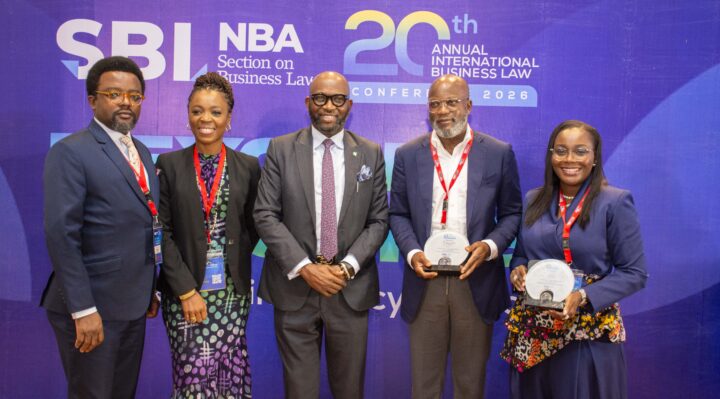


L – R: Conference Planning Committee Chairperson, Oludare Senbore; Partner at Banwo & Ighodalo, Seyi Bella; MD/CEO Renaissance Africa Energy Company, Tony Attah; Managing Partner, TNP, Baba Alokolaro; and Conference Planning Committee Vice Chairperson, Christine Sijuade, at the 20th Annual Conference of the Nigerian Bar Association Section on Business Law (NBA-SBL) in Abuja on Tuesday
The Managing Director and Chief Executive Officer of Renaissance Africa Energy Company, Tony Attah, has urged policymakers and industry stakeholders to shift focus from economic reform announcements to measurable outcomes that improve productivity, investment confidence, and business performance.
Attah made the call at the 20th Annual Conference of the Nigerian Bar Association Section on Business Law (NBA-SBL) in Abuja, where business leaders and policymakers examined whether Nigeria’s ongoing macroeconomic reforms are translating into meaningful gains for the economy.
According to him, the strongest measure of Nigeria’s economic transformation will be the availability of reliable and affordable energy, which remains a major constraint on industrial growth.
“Energy is the single most important input into Nigeria’s real sector, and today, it is also its biggest constraint,” Attah said, highlighting the heavy dependence of businesses on costly self-generated power as a major factor driving up production expenses.
He argued that reforms must ultimately be judged by their impact on businesses, manufacturers, and consumers, particularly through improved electricity supply and stronger industrial capacity.
Attah described Renaissance Africa Energy as a strategic player in Nigeria’s energy transition, with a focus on strengthening energy security, expanding gas supply, and supporting industrialisation through African-led investment.
He disclosed that the company recorded more than 40 percent growth in upstream production within 100 days of taking over operations from The Shell Petroleum Development Company, helping to improve feedstock availability for power generation and industrial users.
The Renaissance CEO said increased investment in natural gas development remains critical to Nigeria’s economic ambitions, describing gas as the foundation for expanding affordable and dependable power supply.
“Gas remains the backbone of industrial power,” he said, noting that unlocking Nigeria’s energy potential would require stronger infrastructure, improved market confidence, and commercially sustainable pricing frameworks.
While describing Nigeria as one of Africa’s most attractive energy markets, Attah acknowledged persistent challenges affecting investors, including foreign exchange instability, infrastructure limitations, and security concerns.
He described the Nigerian market as “high-return, high-friction,” stressing that the next stage of reforms should focus on removing operational barriers, ensuring regulatory stability, and creating conditions that support long-term investment.
According to him, the country’s priority should not only be cheaper electricity but dependable and contract-based power supply supported by a commercially viable energy market.
“Nigeria’s challenge is no longer whether reforms are being introduced, but whether they are delivering tangible results that businesses and citizens can feel,” Attah said.
He added that Renaissance Africa Energy is positioned to support the country’s economic transition by converting its energy resources into sustainable growth, industrial expansion, and broader economic value.