




Pipelines, Power, and Positioning: What Nigeria’s OB3 Project Reveals About Africa’s Energy Future
By Sola Adebawo
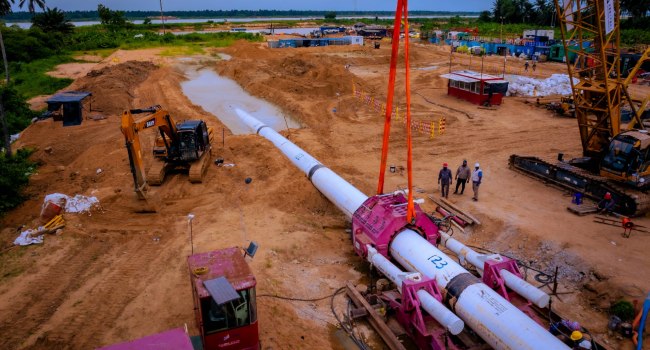
When a pipeline crosses a river, it is often framed as an engineering feat. In Nigeria, the River Niger crossing of the OB3 gas pipeline—executed deep beneath the riverbed using advanced drilling technology—is certainly that. But more importantly, it signals a broader shift in how Africa may begin to structure its energy future: from fragmented assets to integrated systems.
From Resource Wealth to System Weakness
Africa’s energy challenge is not rooted in scarcity, but in connectivity. The continent holds roughly 7% of global natural gas reserves, alongside vast solar and hydropower potential. Yet, according to the International Energy Agency and the World Bank, more than 600 million Africans still lack access to electricity.
This disparity reflects a structural issue. Energy resources are geographically dispersed and often disconnected from demand centres, constrained by weak transmission and transport infrastructure. The challenge has never been discovery—it has been delivery.
What the OB3 Pipeline Changes
The OB3 (Obiafu–Obrikom–Oben) gas pipeline is designed to connect eastern Niger Delta gas supplies to western demand hubs, while linking into the Ajaokuta–Kaduna–Kano (AKK) pipeline corridor extending northward.
With a capacity of up to 2 billion standard cubic feet per day, the project is significant not only in scale but in function. It links gas fields to power plants, supports fertiliser production, and enables industrial clusters—key components of economic diversification.
In a country where gas fuels more than 70% of grid-connected electricity generation—based on data from the Nigerian Electricity Regulatory Commission—the issue has long been availability versus delivery. OB3 begins to close that gap, transforming gas from a stranded resource into a system asset.
The Regional Implication
While the OB3 pipeline is a national project, its implications are regional. Energy infrastructure rarely remains confined within borders. Functional domestic systems often serve as precursors to cross-border integration.
West Africa already has early-stage frameworks, including the West African Gas Pipeline and power pool initiatives under ECOWAS. However, scale and reliability remain limited.
According to the African Development Bank, cross-border electricity trade in Africa is still underdeveloped relative to other regions. OB3 reinforces a key principle: countries must first achieve internal integration before becoming reliable regional energy exporters.
The Economics of Connectivity
Energy infrastructure is often discussed in terms of supply, but its true impact is economic. Integrated systems enable demand aggregation, improve asset utilisation, and enhance investment viability.
Despite its vast needs, Africa accounts for less than 3% of global energy investment, according to the International Energy Agency. This imbalance reflects not just capital constraints, but system readiness. Investors prioritise markets with predictable flows, regulatory clarity, and operational coherence.
Integration reduces risk—and risk reduction drives capital inflow.
Policy as Infrastructure
Engineering builds pipelines; policy determines whether they function efficiently. Across Africa, the core constraints are institutional: regulatory inconsistency, tariff misalignment, weak cross-border coordination, and political uncertainty.
The World Bank has repeatedly emphasised the importance of cost-reflective tariffs and regulatory credibility in sustaining power sector investments.
If engineering complexity defines the first phase of Africa’s energy buildout, institutional capacity will define the next.
Gas in Africa’s Energy Transition
The OB3 project also highlights the enduring role of natural gas in Africa’s energy mix. While global narratives increasingly focus on renewables, Africa’s pathway is more nuanced.
Gas remains central to power generation, industrialisation, and energy access. The International Energy Agency identifies natural gas as a critical transition fuel for the continent—supporting grid stability while enabling economic growth.
Its long-term value, however, depends on execution. Without integrated systems, even gas risks becoming underutilised or stranded.
From Domestic Infrastructure to Global Positioning
As infrastructure scales, Africa’s role in the global energy system evolves—from resource holder to system builder, and ultimately to market participant.
Future competitiveness will not be defined solely by resource endowment, but by the ability to deliver energy reliably, integrate networks across borders, and sustain performance over time.
Conclusion: Beyond the Pipeline
The OB3 pipeline is more than a national milestone—it is a structural signal. It reflects an early but critical transition from fragmented infrastructure toward integrated energy systems.
Africa’s energy future will depend not just on what it has, but on how effectively it connects, distributes, and sustains those resources.
Because while resources create potential, and infrastructure creates access, it is integration that ultimately creates power.
Sola Adebawo is an energy executive, institutional strategy and public affairs leader with deep experience at the intersection of energy, governance, policy, and strategic communication. His writing explores reform, political economy, leadership, culture, and the relationship between institutions and public life. He is an author, scholar, and ordained minister