


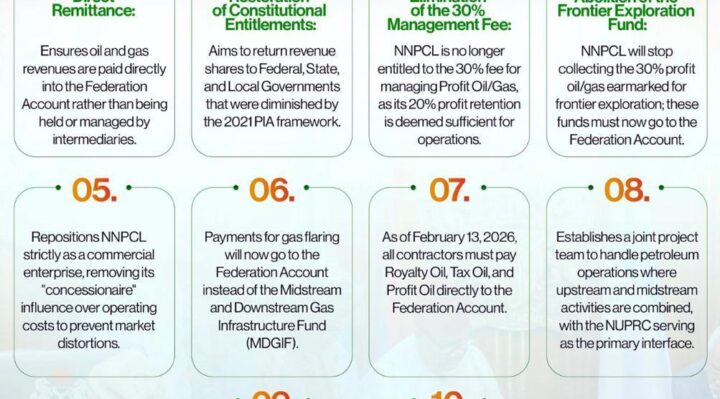


A recent Executive Order issued by Bola Tinubu on aspects of Nigeria’s oil and gas operations has triggered sharp reactions across the industry, with labour leaders and energy experts offering contrasting interpretations of its implications.
The directive, which restructures the remittance framework for key oil and gas revenues, has drawn criticism from the Petroleum and Gas Senior Staff Association of Nigeria (PENGASSAN). The union warned that the move could undermine investor confidence and negatively affect its members.
PENGASSAN argued that the President’s action may send the wrong signal to international investors, particularly at a time when Nigeria is seeking to attract fresh capital into the upstream and midstream segments of the petroleum industry. The association expressed concerns that abrupt policy shifts could create uncertainty within the sector.
However, other stakeholders have taken a different view.
The Group Chairman and Managing Director of International Energy Services Limited, Dr. Diran Fawibe, dismissed fears that the Executive Order would hurt investors. According to him, the intervention does not alter the financial obligations of oil and gas operators but merely changes the destination of certain payments.
“To my mind, the intervention doesn’t affect the amount of money to be paid by operators,” Fawibe said. “It only affects the flow or direction of the monies to be paid.”
He explained that under the new arrangement, revenues that were previously retained within certain structures would now be remitted directly into the Federation Account. In his view, the principal institution impacted by the order is the Nigerian National Petroleum Company Limited (NNPCL).
“It is only the NNPCL that would be affected because it is no longer business as usual with largesse of monies not earned,” he stated, suggesting that the reform aims to reinforce fiscal discipline and transparency.
The Executive Order, which addresses the remittance of royalty oil, tax oil, profit oil, profit gas and other revenues due to the Federation under various contractual arrangements, has therefore opened a broader conversation about governance, investor confidence and revenue management in Nigeria’s oil and gas sector.
While labour groups caution against potential unintended consequences, some analysts interpret the move as a corrective fiscal measure designed to strengthen accountability and improve revenue flows to the federal, state and local governments.
As implementation unfolds, industry watchers say the real impact of the policy will become clearer, particularly in how it shapes investor sentiment and operational dynamics within the petroleum sector.