




Nigeria supplied 53.7 million barrels of crude and condensate to local refineries in the second quarter as NUPRC intensifies enforcement of the Domestic Crude Supply Obligation
The Nigerian Upstream Petroleum Regulatory Commission (NUPRC) has reported an overall 97.4% performance under Nigeria’s Domestic Crude Supply Obligation (DCSO) in the second quarter of 2026, with 53.7 million barrels of crude oil and condensate supplied to domestic refineries between April and June.
The latest figures highlight an improvement in the implementation of the DCSO framework established under Section 109 of the Petroleum Industry Act (PIA) 2021, as Nigeria seeks to secure reliable crude supplies for its expanding domestic refining industry.
NUPRC said the Q2 statistics demonstrate that the DCSO is being actively administered and enforced, with monthly consultations between crude producers and licensed domestic refineries forming a central part of the process.
DCSO performance strengthens in Q2
Under the DCSO framework, NUPRC meets monthly with crude oil producers and domestic refinery operators before allocating volumes that producers are expected to offer to licensed local refineries.
However, the framework operates on a “willing buyer, willing seller” basis, meaning that volumes allocated or offered do not necessarily translate into equivalent quantities ultimately purchased and delivered.
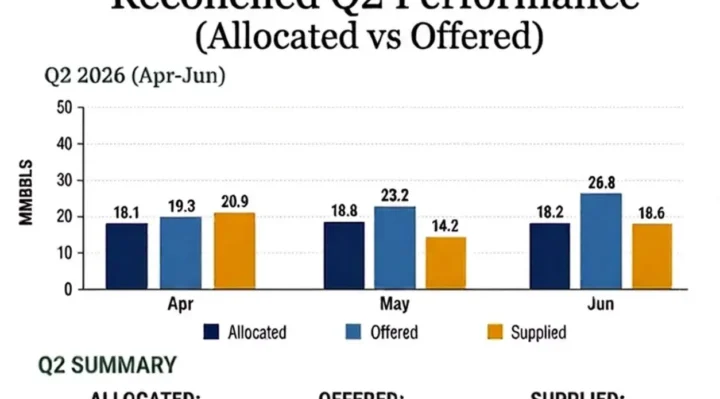
The quarterly performance therefore reflects the interaction between regulatory allocations, producer offers and actual refinery purchases.
April: Supply exceeds allocation
In April, NUPRC allocated 18.13 million barrels of crude oil and condensate to producers for domestic supply.
Producers subsequently offered 19.31 million barrels to local refiners, exceeding their allocated volume.
Actual supplies to domestic refineries reached 20.88 million barrels, representing 114.9% performance against the allocated volume.
The result marked a strong start to the second quarter and demonstrated the potential for actual domestic crude deliveries to exceed regulatory allocations when market participants are able to conclude transactions.
May: Compliance falls below target
The performance weakened in May.
NUPRC allocated 18.78 million barrels to producers, while producers offered 23.19 million barrels to local refineries.
However, actual deliveries stood at 14.23 million barrels, equivalent to 75.8% compliance against the monthly allocation.
The gap between crude offered and crude ultimately supplied highlights the importance of commercial agreements between producers and refiners under the willing-buyer, willing-seller framework.
June: DCSO performance rebounds
Performance recovered strongly in June.
NUPRC allocated 18.17 million barrels to producers, who offered 26.84 million barrels to domestic refiners.
Refiners ultimately took delivery of 18.61 million barrels, representing 102.4% performance against the allocation.
The June recovery helped lift the overall Q2 DCSO performance to 97.4%.
Higher production supports domestic crude supply
NUPRC said the improvement in DCSO performance coincided with increased domestic oil production and the signing of long-term crude supply agreements backed by bankable Sales and Purchase Agreements (SPAs) between producers and domestic refiners.
The development is significant for Nigeria’s refining ambitions.
For several years, inadequate and inconsistent crude supply has been one of the major challenges confronting domestic refineries, even as the country has sought to reduce dependence on imported refined petroleum products.
Longer-term commercial agreements could provide greater certainty for both sides of the market: producers gain clearer visibility over crude sales, while refiners have greater confidence in securing feedstock.
Dangote Refinery dominates Q2 crude offers
The Q2 data also reveal the scale of the Dangote Refinery’s participation in Nigeria’s domestic crude market.
The refinery required approximately 63 million barrels during the quarter, while producers offered it 68.1 million barrels.
The volume offered to the Dangote refinery represented approximately 98% of all crude volumes offered to domestic refineries during the period.
However, the refinery ultimately accepted 52.6 million barrels, equivalent to about 78% of the volume offered.
The figures highlight an important distinction in Nigeria’s DCSO framework: a crude volume being allocated by the regulator or offered by a producer does not automatically mean that the refinery will take delivery of the entire quantity.
Commercial considerations, crude specifications, operational requirements, pricing and other factors can influence the final volume purchased.
DCSO remains central to Nigeria’s refining strategy
Nigeria’s domestic crude supply policy is becoming increasingly important as new and expanded refining capacity changes the country’s downstream petroleum market.
The government’s objective is to ensure that domestic refineries have sufficient access to locally produced crude while allowing producers and refiners to operate within a commercially sustainable framework.
For upstream producers, the DCSO creates an obligation to make specified volumes available to domestic refiners.
For refiners, however, the willing-buyer, willing-seller principle means that crude availability ultimately has to be matched by commercially viable transactions.
The Q2 data demonstrate both the progress and the challenges of that model.
NUPRC pledges continued enforcement
NUPRC reaffirmed its commitment to supporting Nigeria’s objective of achieving greater energy sufficiency through sustained implementation of the DCSO provisions of the Petroleum Industry Act 2021.
The Commission said it would continue working to sustain recent improvements in crude production while enforcing the domestic supply obligation.
The Q2 results suggest that Nigeria is making progress towards establishing a stronger link between its upstream oil production and rapidly expanding domestic refining capacity.
For investors and international energy companies, the development could become increasingly important.
If crude production continues to rise, long-term supply agreements deepen and DCSO enforcement becomes more predictable, Nigeria could gradually establish a more integrated domestic oil value chain—linking upstream production, crude evacuation, refining and domestic petroleum supply more closely than it has in the past.
The challenge now is to sustain the 97.4% performance while ensuring that regulatory allocations translate consistently into commercially executed crude transactions and physical deliveries.
That will be critical to determining whether Nigeria’s emerging refining capacity can operate at scale and whether the country can convert its crude resources into greater domestic energy security and economic value.