




Nigerians are facing renewed pressure from rising petrol and cooking gas prices following fresh US military strikes on Iran, a development that has triggered another surge in global crude oil prices and heightened fears of prolonged energy market disruptions.
The latest escalation in the Middle East has deepened concerns over the cost of living in Africa’s largest economy, where households and businesses are already struggling with inflation, naira weakness, and rising transportation costs.
Global benchmark Brent crude climbed 3.75 percent to nearly $98 per barrel, while US crude rose about 4 percent after the United States launched new strikes on Iranian military targets in Bandar Abbas, a strategic port city close to the Strait of Hormuz.
The US Central Command (Centcom) said its forces also intercepted four Iranian drones near the Strait of Hormuz, a critical shipping corridor through which nearly one-fifth of global oil and liquefied natural gas (LNG) supplies pass daily.
The renewed tensions come despite ongoing ceasefire negotiations between Washington and Tehran following months of conflict involving the United States, Israel, and Iran.
For Nigerians, the global crisis is already translating into higher energy costs, with marketers warning that fuel and cooking gas prices may remain elevated if instability persists in the Gulf region.
Across Lagos, Ogun, and several other states, retail prices of Liquefied Petroleum Gas (LPG), commonly known as cooking gas, have surged sharply in recent months.
Cooking gas, which sold for below N1,000 per kilogram earlier this year in some locations, now ranges between N1,750 and N2,000 per kilogram depending on the outlet and distribution costs.
Petrol prices have also remained high, ranging between N1,310 and N1,400 per litre in many filling stations, worsening transportation costs and increasing financial pressure on households and small businesses.
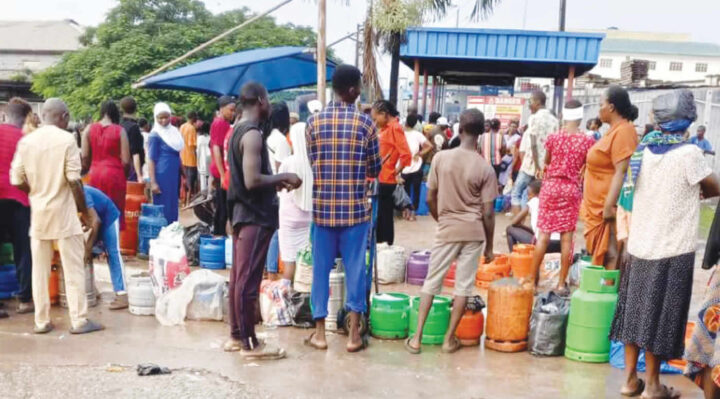
At several gas retail outlets visited in Lagos and Ogun states, consumers carrying cylinders were seen leaving without refilling after discovering they could no longer afford the prevailing prices.
The situation is compounding hardship for low-income households that depend on LPG for cooking following years of government campaigns encouraging cleaner cooking energy and reduced dependence on firewood and kerosene.
Energy analysts say Nigeria’s vulnerability to global oil price shocks persists despite being Africa’s largest crude oil producer because the country still relies heavily on imported refined petroleum products and remains exposed to international shipping and foreign exchange costs.
Speaking on the development, Managing Director of Gas Terminally, Felix Ekundayo, attributed the increase in cooking gas prices to the worsening crisis in the Middle East.
“The conflict in the Middle East has pushed up the cost of energy around the world,” he said.
The Strait of Hormuz remains central to the crisis. Since the US and Israel launched coordinated strikes on Iran on 28 February, Tehran has repeatedly threatened shipping activities in the waterway, raising fears of supply disruptions across global energy markets.
The prolonged uncertainty has also increased maritime insurance premiums, freight costs, and supply chain risks for oil and LNG cargoes destined for international markets, including Africa.
Economists warn that sustained increases in global oil prices could further weaken Nigeria’s fragile economic recovery by fueling inflationary pressures, raising logistics costs, and reducing consumers’ purchasing power.
The rising cost of petrol is already affecting public transportation fares, food distribution, manufacturing expenses, and electricity generation costs for businesses dependent on diesel and gas-powered systems.
Industry observers also note that while higher crude oil prices could boost Nigeria’s export earnings and government revenues in the short term, ordinary Nigerians are unlikely to benefit immediately because of persistent refinery limitations, foreign exchange instability, and market-driven fuel pricing under the deregulated downstream sector.
With no immediate resolution in sight between the US and Iran, energy traders and Nigerian consumers alike are bracing for further volatility in the global oil and gas market
Nigeria still imports part of its Liquefied Petroleum Gas (LPG) needs. Still, domestic production has increased significantly over the past two years due to rising output from the Nigeria LNG Limited (NLNG), the Dangote Refinery, and other gas processing plants.
According to industry and regulatory data for 2025:
- Nigeria’s total LPG supply reached about 1.6 million metric tonnes (MT) in 2025.
- Domestic production accounted for roughly 86–87% of supply.
- Imports accounted for approximately 13–14% of total supply.
Using the 1.6 million MT total market estimate:
- Domestic LPG production: about 1.38 million MT
- Imported LPG volume: about 210,000–220,000 MT
NLNG alone says it now supplies more than 500,000 metric tonnes annually to the domestic market, covering roughly 30% of Nigeria’s LPG demand.
The sharp increase in local supply is largely linked to:
- Increased LPG output from NLNG
- Production from the Dangote Refinery
- Supply from inland gas processing plants such as Kwale, Ovade, Greenville, and others.