


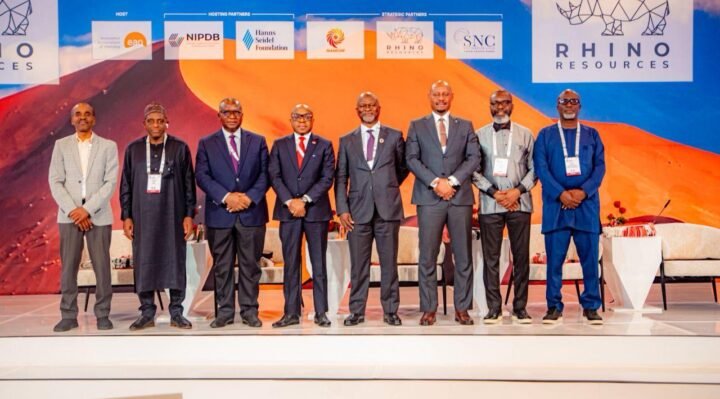


The Nigerian Content Development and Monitoring Board (NCDMB) has called for deeper integration of African local-content policies and stronger cross-border business partnerships to help the continent retain more value from its oil and gas resources and accelerate industrial development.
The Board said Africa has developed significant capabilities in engineering, fabrication, manufacturing, subsea services, marine operations and project execution, but fragmented markets, regulatory differences and limited access to finance continue to prevent African companies from fully exploiting those capabilities.
The NCDMB made the case during a strategic engagement in Windhoek on “African Local Content Opportunities: Pathway to Economic Diversification and Development,” held alongside the 2026 Namibian Oil and Gas Conference (NOGC).
Representing NCDMB Executive Secretary, Engr. Felix Omatsola Ogbe, Dr. Abdulmalik Halilu said the next phase of African local-content development should move beyond individual-country policies towards a Pan-African industrial ecosystem in which companies can combine capabilities, access markets and jointly execute major energy projects across borders.
NCDMB: Africa must build an integrated local-content market
Halilu said a number of African oil and gas-producing countries have established legal and regulatory frameworks designed to increase domestic participation in their energy industries.
While such frameworks have helped develop national suppliers and skills, he argued that the continent could generate significantly greater economic benefits if those capabilities were connected across national borders.
He said African local content should therefore not be viewed solely through the lens of nationality or geographical boundaries, but as a mechanism for developing and deploying African capacity wherever it exists.
“African local content should promote the development and utilisation of cross-border capacities and capabilities as a catalyst for the industrialisation of Africa,” Halilu said.
According to him, a company in one African country should be able to partner with an engineering, fabrication, logistics or technology company in another country to bid for and execute major projects without unnecessary regulatory or administrative barriers.
Such integration, he said, would expand the market available to African businesses while allowing energy companies to source more goods and services from within the continent.
Brazzaville Declaration provides policy framework
Halilu referenced the 2025 APPO Ministerial Council Brazzaville Declaration as an important framework for strengthening African participation in the oil and gas industry.
The declaration’s aspirations include building supplier capacity, developing skills, facilitating knowledge and technology transfer, promoting joint ventures and strategic partnerships, harmonising local-content regulations and encouraging public-private partnerships.
For NCDMB, the challenge now is translating those policy objectives into commercially viable partnerships and measurable increases in African participation in energy projects.
Halilu said implementation would be more important than declarations alone, arguing that African governments and industry stakeholders must create mechanisms that allow businesses to collaborate across borders.
“The Brazzaville Declaration represents an important starting point, but implementation, partnership and policy alignment will ultimately determine the success of Pan-African local content,” he said.
Nigeria offers local-content model
The NCDMB delegation used Nigeria’s experience as an example of how sustained local-content policy, monitoring and investment can transform an oil and gas supply chain.
Halilu highlighted the impact of the Nigerian Oil and Gas Industry Content Development (NOGICD) Act, which established a framework for increasing Nigerian participation in the country’s petroleum industry.
He said Nigeria’s experience demonstrated the importance of combining regulation with reliable data, compliance monitoring, supplier development and targeted investments.
The NCDMB has increasingly positioned local content as more than a regulatory requirement, with emphasis on developing companies capable of competing for increasingly sophisticated contracts in the energy industry.
According to Halilu, Africa can adapt lessons from Nigeria’s experience while recognising that each country’s regulatory and industrial circumstances are different.
The objective, he said, should be to develop a continental network of capable businesses that can jointly compete for projects previously dominated by international contractors.
Cross-border partnerships could reshape African energy supply chains
Halilu identified several commercial models that could help African businesses collaborate on major projects.
These include:
- Prime contractor-subcontractor arrangements, allowing companies to combine complementary technical capabilities;
- Incorporated local-content joint ventures, through which businesses from different African countries can jointly invest and execute projects;
- Contractual consortiums, enabling several African companies to bid collectively for large contracts; and
- Reciprocal market-access alliances, allowing companies to enter new African markets through strategic partnerships.
He said such arrangements could allow smaller and medium-sized African enterprises to participate in projects that would otherwise be beyond their individual financial or technical capacity.
The approach could also improve technology transfer, create larger regional supply chains and increase the share of oil and gas project expenditure retained within Africa.
Regulation, trade and finance remain major barriers
The NCDMB said building an integrated African local-content market would require cooperation beyond the oil and gas sector.
Key areas requiring greater alignment include regulation, customs procedures, trade facilitation, immigration, movement of skilled workers and access to long-term financing.
Differences in local-content requirements, certification procedures and tax or customs regimes can increase the cost and complexity of cross-border projects.
Halilu therefore advocated closer cooperation among governments and regulatory agencies to reduce those barriers.
He also backed the development of a Pan-African supplier database and interactive opportunities platform that would allow project developers and contractors to identify qualified African companies across different technical and service categories.
Such a platform, he said, could help transform local-content development from a collection of national databases into a continental marketplace for energy-sector capabilities.
AfCFTA could provide continental platform
The NCDMB also called for greater use of the African Continental Free Trade Area (AfCFTA) framework to support the movement of African goods, services, skills and investment.
Halilu said deeper alignment between AfCFTA objectives and local-content policies could give indigenous companies access to a much larger market and allow them to scale beyond the limitations of their domestic economies.
For Africa’s emerging oil and gas producers, including countries developing new petroleum provinces, this could be particularly important.
Rather than creating entirely new supplier ecosystems in every oil-producing country, governments could leverage established capabilities elsewhere on the continent while simultaneously developing domestic capacity.
The result, NCDMB argued, could be a more efficient and competitive African energy supply chain.
NCDMB shares global best practices with Namibia
During the first panel session, NCDMB Director of Monitoring and Evaluation, Mr. Esueme Dan Kikile, Esq., shared perspectives on global best practices for strengthening local participation and maximising in-country value in the oil and gas industry.
Kikile encouraged Namibian stakeholders to examine practical approaches to supplier development, skills transfer, enterprise growth and sustainable local-content implementation.
The discussions examined lessons from other oil-producing countries and how those experiences could be adapted to Namibia’s emerging petroleum industry.
For Namibia, which is seeking to translate its emerging oil and gas opportunities into broader economic development, the discussions offered an opportunity to examine how local suppliers, workers and businesses can be positioned before large-scale petroleum developments reach full production.
Namibia Vice President visits NCDMB exhibition stand
The NCDMB’s participation at the conference also provided an opportunity for bilateral engagement and knowledge exchange.
During an exhibition tour at the 2026 Namibian Oil and Gas Conference, Namibia’s Vice President, Lucia Witbooi, visited the NCDMB exhibition stand.
She was received by Kikile and other NCDMB officials, who presented the Board’s mandate, programmes and experience in developing Nigerian participation in the oil and gas industry.
Kikile highlighted the significance of the NOGICD Act and its role in transforming Nigeria’s petroleum industry by providing a structured framework for increasing indigenous participation.
He also emphasised the importance of regional cooperation and knowledge exchange in building sustainable energy industries across Africa.
From national local content to a Pan-African industrial strategy
The NCDMB’s intervention reflects a broader shift in the African energy debate: from simply requiring foreign investors to source locally towards building competitive African supply chains capable of serving multiple markets.
For international investors, such integration could eventually provide a larger pool of qualified African contractors and suppliers, potentially reducing project costs and improving access to regional expertise.
For African businesses, the opportunity is even more significant. A company that can successfully operate across several African markets has a larger addressable market, greater potential to achieve economies of scale and stronger prospects for competing with global service providers.
But achieving that vision will require more than policy statements. Governments will need to reduce regulatory fragmentation, companies will need to form commercially sound partnerships, financial institutions will need to support expansion, and regulators will need to develop mechanisms that recognise capabilities across borders.
The NCDMB believes the foundations already exist.
The next challenge is to connect them.
If successfully implemented, a Pan-African local-content framework could help Africa move from being primarily a producer and exporter of natural resources to becoming a continent where a greater share of the engineering, manufacturing, technology, services and industrial value created by those resources remains within Africa.
SEO keywords: NCDMB, Pan-African local content, African oil and gas industry, Nigeria local content, AfCFTA, African energy sector, NOGICD Act, APPO Brazzaville Declaration, Namibia oil and gas, African industrial development, oil and gas local content, African supplier development, Nigeria Content Development and Monitoring Board.