


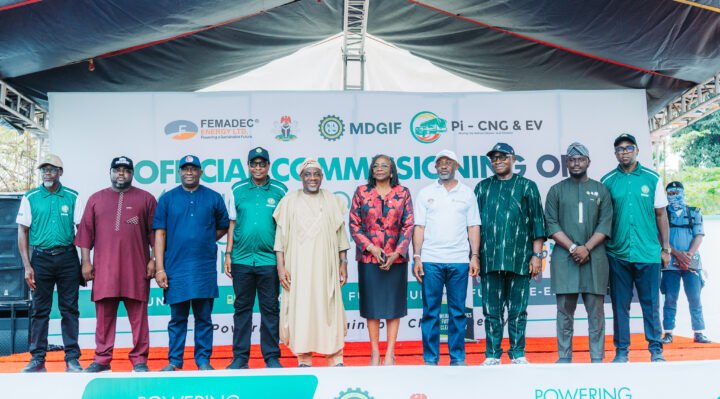


The Midstream and Downstream Gas Infrastructure Fund (MDGIF) has commissioned compressed natural gas (CNG) refuelling infrastructure at four universities in Lagos, Ekiti, Oyo and Ondo states as part of the Federal Government’s drive to expand domestic gas utilisation and reduce transportation costs for students and staff.
The facilities, commissioned on Friday, November 20, 2026, are located at the University of Lagos (UNILAG), University of Ibadan, Federal University of Technology Akure and Federal University Oye-Ekiti.
The initiative, implemented in partnership with FEMADEC Energy Limited, is designed to bring CNG refuelling infrastructure closer to tertiary institutions and support the adoption of cheaper alternative fuels for transportation.
Speaking at the commissioning ceremony in Lagos, Executive Director of MDGIF, Oluwole Adama, said the projects reflected the Federal Government’s commitment to translating Nigeria’s gas resources into infrastructure and economic opportunities for citizens.
He said the commissioning, which involved simultaneous participation from the four universities, represented a shared effort to expand CNG infrastructure across the country. Adama disclosed that nine additional CNG stations, mostly in northern Nigeria, would be commissioned within the coming weeks, further extending the programme’s geographical reach. According to him, MDGIF’s portfolio currently comprises 31 projects involving 205 infrastructure assets nationwide, while the fund has supported the delivery of 25 fully operational CNG stations in the past two years.
He described the UNILAG facility as the 11th CNG station commissioned in Lagos State, saying the growing number of stations indicated that natural gas was increasingly becoming part of Nigeria’s transportation fuel market.
The four university projects are being implemented under Project SPROUT, a Federal Government initiative aimed at reducing commuting costs for students and university employees through the adoption of CNG-powered transportation.
Adama credited President Bola Tinubu’s Renewed Hope Agenda and Presidential CNG Initiative for providing the policy direction and political support for the projects.
He also commended the Minister of Education for engaging university vice-chancellors and facilitating the allocation of land for the facilities, saying the minister’s intervention was instrumental to the implementation of the initiative across the four institutions.
The MDGIF executive director further acknowledged the contributions of the Minister of State for Petroleum Resources (Gas), the National Assembly, the Authority Chief Executive, FEMADEC Energy, host governments, university authorities and local communities. Established under Section 52 of the Petroleum Industry Act, MDGIF is mandated to support viable gas infrastructure investments and accelerate the development of midstream and downstream gas facilities.
Adama said the programme’s impact should extend beyond the availability of fuel to creating opportunities for skills development, research, innovation and entrepreneurship among university students.
He urged students of the University of Lagos to explore career opportunities in engineering, digital systems, safety, maintenance, research and energy enterprise associated with CNG infrastructure.
He said universities should not only host energy infrastructure but also develop the talent, innovation and technical expertise required to support the industry’s growth.
Adama stressed that the success of the commissioned facilities would depend on safe operations, reliable gas supply and the creation of practical opportunities for learning and enterprise.
The latest commissioning builds on MDGIF and FEMADEC’s existing university-based CNG infrastructure at Yakubu Gowon University in Abuja, Federal University of Technology Owerri, Obafemi Awolowo University in Ile-Ife, University of Uyo, University of Calabar, Federal University of Petroleum Resources in Effurun and University of Nigeria’s Enugu Campus.
The expansion forms part of broader Federal Government efforts to deepen CNG adoption, diversify Nigeria’s transportation energy mix and leverage its natural gas resources to lower mobility costs.