




Repair and restoration costs for energy-linked infrastructure as a result of war in the Middle East could hit $58 billion, Rystad Energy analysis shows, with the total for oil and gas facilities potentially up to $50 billion.
“This is no longer just a story about damaged facilities in the Gulf.
It is a stress test for the global energy supply chain.
The same equipment and contractors needed to rebuild are already committed to a wave of LNG and offshore projects sanctioned since 2023.
Repair work does not create new capacity, it redirects existing capacity, and that redirection will be felt in project delays and into inflation far beyond the Middle East.
The $58 billion bill is the headline, but the knock-on effects on energy investment timelines globally may prove just as significant.”
Repair and restoration costs for energy-linked infrastructure as a result of war in the Middle East could hit $58 billion, Rystad Energy analysis shows, with the total for oil and gas facilities potentially up to $50 billion.
Three weeks after we published an initial estimate of $25 billion in repair costs across Gulf energy infrastructure, the scope of damage has expanded materially.
The continuation of military strikes drove up the number of impacted assets across the region before largely subsiding following an 8 April ceasefire between the US and Iran.
This pushed the estimate for the average in potential total repair and restoration spending to $46 billion – representing the midway point in the range of $34 billion to $58 billion – across oil and gas infrastructure, inclusive of an average of $5 billion across industrial, power and desalination assets.
The ceasefire, combined with stalled negotiations and renewed escalation risk, continues to shape the operating environment, alongside risks of disruption and potential blockades affecting shipping through the Strait of Hormuz.
Divergent recovery timelines
This broader damage footprint is changing how the recovery will unfold.
Capital availability is not the primary constraint; instead, access to equipment, contractors and logistics is emerging as the key limiting factor.
Recovery timelines are beginning to diverge across assets and countries, reflecting differences in domestic execution capacity and supply chain access.
At the same time, repair activity is likely to displace new project execution, as operators prioritize restoring existing production over advancing greenfield developments.
Early recovery trends already reflect this divergence.
Some facilities where damage was contained and contractor capacity was already present have resumed operations within weeks, particularly where work is limited to surface equipment and modular repairs.
By contrast, facilities requiring reconstruction of core process units or that are dependent on long-lead equipment remain in early assessment stages, with timelines extending into years.
Rystad Energy has assessed the damage across impacted energy-linked facilities and estimates total repair and restoration costs in the range of $34 billion to $58 billion (Figure 2).
The lower end of the range assumes that, for facilities where the extent of damage is not yet fully clear, impacts are limited in scope, allowing for modular repairs supported by existing spare equipment and shorter procurement cycles.
The upper end reflects scenarios where structural damage is confirmed across major facilities, requiring full replacement of critical systems, reliance on long-lead equipment and the inclusion of conflict-related premiums on engineering, procurement and construction (EPC) execution, including contractor mobilization and war-risk insurance, alongside delays linked to contractor deployment, constrained logistics and in some cases restricted access to international supply chains.
This distribution is reflected in the cost split across facility types.
Downstream refining and petrochemical assets account for the largest share, reflecting both their complexity and the extent to which they were impacted in later stages of the ongoing war.
Midstream and upstream assets follow, while wells and industrial infrastructure contribute smaller but still material portions.
Overall, repair costs for the oil and gas sector are estimated at between $30 billion and $50 billion, with non-hydrocarbon infrastructure including aluminum smelters, steel plants, power stations, and desalination facilities adding a further $3 billion to $8 billion.
Iran and Qatar bear brunt
At a country level, this cost distribution begins to diverge more clearly, both in scale and across asset types.
Iran accounts for the highest number of impacted facilities and the widest spread across asset types, with repair costs potentially reaching up to $19 billion under a high-damage scenario.
Major disruptions are concentrated in the South Pars onshore gas processing facilities at Asaluyeh, along with the adjacent Pars Special Economic Energy Zone and Mahshahr petrochemical complex, removing significant gas processing and downstream petrochemical capacity.
Additional impacts across key refineries, fuel storage depots in the Tehran region and export infrastructure at Lavan and Siri Island have further constrained domestic fuel distribution and reduced export flexibility, increasing reliance on fewer operational outlets.
The impact in Iran therefore extends across the value chain, with simultaneous disruption to processing, refining, storage, and exports.
Restoration timelines are structurally longer than elsewhere in the Gulf, not only due to the scale and dispersion of damage, but also because access to Western EPC contractors, original equipment manufacturers and process technologies remains restricted, narrowing execution options and extending procurement cycles.
Qatar presents a different profile, where the impact is more concentrated but significantly deeper in terms of technical complexity.
Damage is centered on Ras Laffan Industrial City, where multiple liquefied natural gas (LNG) trains have been affected alongside disruption at the Pearl gas-to-liquids facility.
This is now intersecting with QatarEnergy’s ongoing North Field expansion program, including the latest award to a consortium led by Technip Energies, with contractors already active across multiple phases.
With these projects already under execution or in early construction, there is a clear overlap between expansion work and repair activity within the same industrial cluster.
Both draw on similar pools of engineering teams, fabrication yards and site crews, even if not always the same contractors.
If some of this capacity is redirected towards repair activity, it could lead to delays of a few months in ongoing expansion projects, especially where timelines are already tight.
The impact is more likely to show up as slower progress on execution rather than any formal change in project schedules.
E&C takes largest share of costs
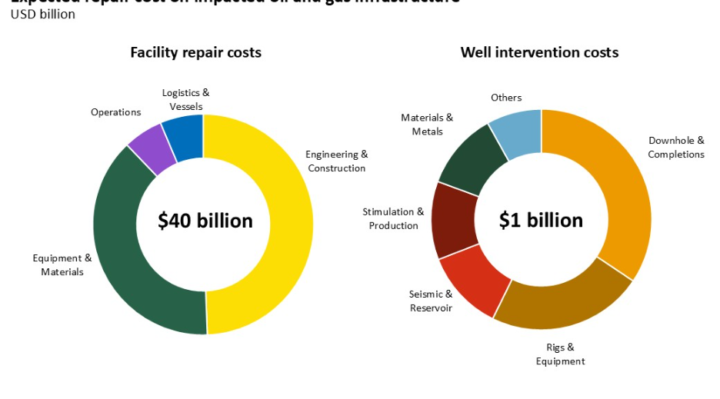
Rystad Energy estimates facility repair and restoration costs for impacted oil and gas facilities could cost about $46 billion (Figure 5).
At the facility level, engineering and construction accounts for the largest share of total expected outlay, followed by equipment and materials.
This is consistent with the dominance of downstream and integrated assets in the damage profile, where repair activity involves rebuilding structural components, reinstating process units and re-integrating complex systems.
The sequencing of spending is equally important.
Engineering and assessment activity progresses relatively quickly, but the overall timeline is largely governed by procurement and fabrication of critical equipment.
While construction and installation can proceed in parallel once materials are available, delays in equipment delivery continue to define the critical path across most major assets.
As a result, recovery timelines are less dependent on on-site execution and more on how quickly operators can secure access to constrained supply chains.
What is emerging is less a reconstruction program and more a competition for access – access to equipment, contractors and logistics capacity.
Those that move early will secure capacity and shorten timelines, while others may face delays that extend well beyond the physical scope of damage.
The pace of recovery will therefore be defined less by the scale of impact and more by access to constrained supply chains.
Elliot Busby
VP, Head of Media & Communications