




ABUJA — The Democratic Republic of Congo (DRC) has begun a high-level study tour of Nigeria’s oil and gas local-content institutions as it seeks to adapt elements of the Nigerian model to strengthen domestic participation in its petroleum industry.
The delegation, led by DRC Minister of Hydrocarbons Simplice Stev Onanga, arrived in Nigeria to study the framework developed by the Nigerian Content Development and Monitoring Board (NCDMB) and examine how Nigeria has built local capacity in oil and gas operations, manufacturing and services.
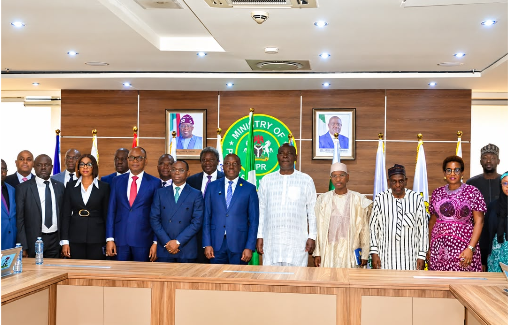
Nigeria’s Minister of State for Petroleum Resources (Oil), Heineken Lokpobiri, received the delegation in Abuja on Monday, describing the engagement as part of Nigeria’s efforts to share technical and institutional experience with other African petroleum-producing countries.
Lokpobiri said the knowledge-sharing initiative was particularly relevant under the African Petroleum Producers Organisation (APPO), as African countries seek to develop their petroleum resources while retaining more value within their economies.
Nigeria targets 70% local content
Lokpobiri said Nigeria had reached about 61% local content capacity since the enactment of the Nigerian Oil and Gas Industry Content Development (NOGICD) Act 16 years ago.
He said the policy had helped expand Nigerian participation across the petroleum value chain, while the divestment of some onshore assets by international oil companies had created additional opportunities for indigenous operators.
Companies including Renaissance Africa Energy Company, Seplat Energy Producing Unlimited and Oando Energy Resources Nigeria Limited have acquired or participated in the ownership and operation of assets divested by international oil companies.
“The solution to Africa’s energy challenges lies within Africa,” Lokpobiri said, noting that Nigeria currently produces more than 1.8 million barrels of crude oil per day.
He said international companies continued to play a significant role in deepwater operations, while Nigerian operators and service companies had expanded their presence in onshore and shallow-water assets.
Local content fund supports domestic capacity
The minister also highlighted the financing mechanism underpinning Nigeria’s local-content programme.
He said industry participants fund the Nigerian Content Development Fund (NCDF) through a 1% levy on upstream oil and gas contracts, providing resources for developing indigenous technical and industrial capacity.
Lokpobiri assured the DRC delegation that Nigeria would share its experience and institutional knowledge as Kinshasa develops its own framework.
NCDMB offers institutional support
The NCDMB Executive Secretary, Felix Omatsola Ogbe, represented at the engagement by the Director of Corporate Services, Abdulmalik Halilu, said the Board was prepared to support the DRC in developing a sustainable local-content framework.
Halilu highlighted Nigeria’s regulatory institutions, coordination mechanisms and long-term planning as key elements of the country’s local-content architecture.
He said the NCDMB’s 10-year strategic roadmap targets 70% in-country value retention and more than 300,000 direct jobs by 2027.
The framework covers areas including indigenous participation, fabrication, engineering, manufacturing, employment, technology transfer and the development of Nigerian-owned oil and gas service companies.
DRC seeks to replicate Nigerian experience
Onanga said the DRC was interested in understanding how Nigeria had built domestic capacity around its petroleum industry.
“We are proud to be in Nigeria to witness what has been accomplished,” he said.
The DRC’s interest comes as African oil and gas producers face growing pressure to capture more value from their natural resources locally rather than relying heavily on imported equipment, foreign expertise and offshore supply chains.
For Kinshasa, Nigeria provides a regional case study of how legislation, dedicated institutions and industry financing can be combined to increase domestic participation in the petroleum sector.
Study tour covers Bayelsa, Onne and Lagos
The study tour will continue through Friday and includes visits to major Nigerian oil and gas institutions and industrial facilities.
The delegation is scheduled to visit the NCDMB headquarters in Bayelsa State, fabrication facilities in the Onne Free Zone, an NLNG supplier engagement session and the UniPort Gas Centre.
The programme will also include visits to LADOL and Nigerdock facilities and other industry engagements.
The tour provides an opportunity for the DRC delegation to examine Nigeria’s local-content system beyond its regulatory framework, including the industrial infrastructure, supplier-development programmes and private-sector ecosystem that support domestic participation in the oil and gas value chain.