




…11plc boss, Tunji Oyebanji, says government must prioritise opportunities for optimal promotion of harmony between policy and operations.
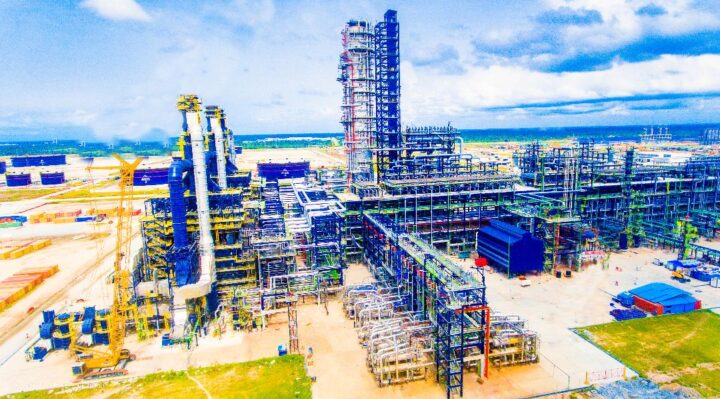
In Preparatory for its take-off, the 650,000 barrels per day (bpd) Dangote Refinery complex has been pre-commissioned and issued Licence to Introduce Hydrocarbon. This will enable the company to start full production of the various petroleum products it desires to take to the market.
The Chief Executive of the Nigerian Midstream and Downstream Regulatory Authority NMDRA, Farouk Ahmed disclosed this at the ongoing Oil and Logistics (OTL) 2023 Africa Downstream Energy Week in Lagos.
The Authority Chief who delivered the Keynote address with the theme: Energy Synergy and New Beginnings disclosed that one of our main focus has been to enable the growth of the Industry, in line with the provision of the Petroleum Industry Act (PIA), stating further that the Authority has been issuing relevant licences for the establishment and operationalization of midstream and downstream, facilities.
“Significantly, the 650,000 bpd Dangote refinery complex has been
Pre-commissioned and issued Licence to Introduce Hydrocarbon, while a combined capacity of 29,500 bpd modular refineries are operating & supplying various petroleum products in the Country. In addition, existing NNPC refineries with a combined capacity of 445,000 bpd are currently being rehabilitated. We believe that Nigeria will achieve a net export position of products in the near term when the planned and rehabilitated refineries become operational.”
He said that in order to ensure an adequate supply of products through importation, for guaranteed energy security, the Authority has developed and released a set of guidelines that are transparent with a fully automated application platform that guarantees efficient processing and issuance of licences and permits.
He stated that as it has been demonstrated over time, the Authority remains committed to strategic stakeholder collaborations and engagements. “Our regulatory activities would remain focused on enabling businesses based on clear industry requirements aligned with international best practices and pragmatic national objectives.”
“We shall therefore continue with our periodic engagements with the
industry whence we collectively shape the growth of each subsector.
The NMDPRA shall also continue to support the OTL and other
platforms that facilitate industry growth and collaboration.”
The Authority Chief assured the industry of the agency’s continued
dedication to effectively deliver the PIA mandates. “We are continuing necessary engagements with stakeholders to finalise the revision of domestic base price of natural gas and we shall soon be releasing the revised Gas Transportation Network Code; Guidelines for National Strategic Stock; and; Launch the NMDPRA Industry Sustainability Initiative (NISI)”
He explained that data has revealed that after the announcement of deregulation, an average volume of 44.3 million liters per day was evacuated for distribution nationwide which implies a 33.58% reduction from the 66.7 million liters per day before the deregulation.
“The supply of PMS and other Petroleum products have all maintained average land sufficiency levels above required thresholds. Our market intelligence regulatory role shall continue to be strengthened to ensure that all provisions of the PIA with respect to the establishment of a strong competitive environment are fully implemented.
Meanwhile, Ninety-Four (94) wholesale suppliers were issued permits
to import PMS into the country. Eight (8) suppliers delivered 8 cargoes of PMS totaling 251,000 MT within the period June – September 2023. This low performance was due to the challenge of forex illiquidity which has constrained the Oil Marketing Companies’ ability to import the product.
“But we are hopeful that the necessary efforts being taken by the government to improve the stability of harmonized forex market will support the importation of PMS by more Oil Marketing Companies alongside NNPCL.”
Earlier, in his welcome address, Adetunji Oyebanji, Chairman
OTL Africa Downstream Energy Week stated that in line with the strong interest this year, the sessions touch on the critical areas that define downstream energy operations, policy and support services.
According to him, governments at the highest levels can never be too busy to engage with industry and must prioritise opportunities for optimal promotion of harmony between policy and operations. In this regard, we are happy we have the full representation of the Nigerian government’s downstream petroleum operations and regulation in the room today, led by the Nigerian Midstream and Downstream Petroleum Regulatory Authority. “We particularly appreciate the seriousness the Authority has attached to this event, designating it as a key platform for its engagement with the industry, not just through the OTL Downstream Energy Week, but also in achieving market harmony, fostering competition and facilitating dispute resolution.”
He said in the course of the next four days, there will be eleven diverse sessions that target the most important concerns of our businesses.
Global economic challenges, he said, have fuelled renewed urgency to diversify operations in order to maximize the sector’s potential. This renewed consciousness has resulted in significant investment in key elements of the value chain, indicating a paradigm shift that emphasizes technological evolution, capacity development, supply chain efficiency and value addition.
“From rig to ship to depot to truck to the last mile, there is no shortage of effort by the industry. However, policy development and implementation need to keep pace with the urgency of industry needs and the appetite of market operators. Nonetheless, there is no doubt that there is huge potential. While the market is hopeful and actively positioning for the future, the reality remains that things have been tough for many, albeit with a silver lining – a quest for reduced costs and increased efficiency, a tilt to innovation and an inevitable recourse to technology. With lost earnings potentially replaced by increased savings and efficiencies, the canvass before us remains one of the great opportunities.”
“It is therefore important that everything is done to harness these opportunities. Though global energy palate is becoming increasingly discriminatory in favour of efficiency and negative emissions, it is notable that this is happening at a time when global hydrocarbon reserves are expanding. Multiple countries on the continent have become oil-producing, while major investments in petroleum refining are nearing completion. But the transition to alternative energy seems inexorable, adding to a mix of circumstances of interest for us as a continent.”