


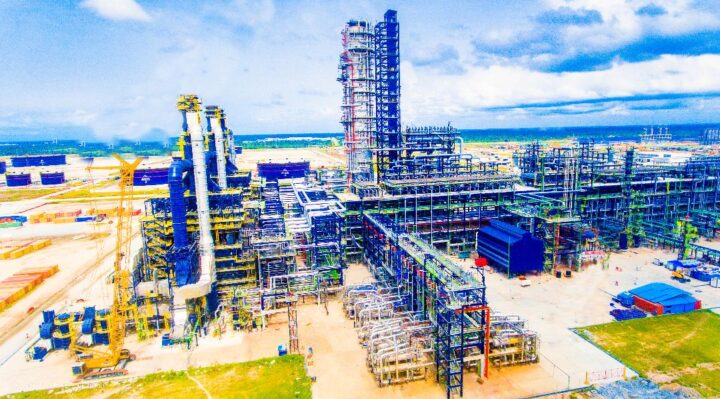


Dangote Refinery Assures Nigerians of Steady Fuel Supply Despite Middle East Tensions as Adeyanju Criticises Price Increase
The Dangote Refinery has assured Nigerians that the ongoing tensions involving the United States, Israel and Iran will not disrupt crude oil supplies to the facility or affect fuel availability in the country.
The company said its crude supply chain remains stable because it sources feedstock primarily from Nigeria and the United States, insulating its operations from the geopolitical developments in the Middle East.
Speaking on the issue, the Group Brand Manager of Dangote Group, Tony Chiejina, said the refinery’s crude supply has not been impacted by the conflict, adding that Nigerians should not fear any shortage of petroleum products.
According to him, the refinery’s operations have helped Nigeria avoid the challenges that often arise when international crises push up the cost of imported fuel.
He explained that before the commencement of local refining, such global tensions would typically result in higher import costs and possible fuel scarcity in Nigeria.
“Ordinarily, marketers would already be complaining about the high cost of importing fuel or claiming difficulties in sourcing products for the Nigerian market,” Chiejina said.
He noted that such a situation could have triggered long queues at filling stations nationwide, with attendant economic and security implications.
Chiejina therefore urged Nigerians to appreciate the role of the Dangote Refinery in stabilising the domestic fuel market, stressing that its operations have shielded the country from potential disruptions that could have arisen from the international crisis.
The assurance comes amid public reactions to the recent increase in the pump price of petrol by the refinery.
Some Nigerians have questioned the justification for the price adjustment, especially as the federal government’s naira-for-crude policy was expected to serve as a buffer against external shocks in the global oil market.
“True. But given that we have been told that crude for Naira is to protect Nigerians from in crude price volatility, it would be nice for us to know what percentage of his crude is local and what percentage is imported. In addition how much finished product is being exported. Since we(Nigeria)are not getting full value for our crude sold in Naira I think more transparency is needed,” a stakeholder stated
Another stakeholder also reacting, said: “ I am wondering how to situate this against the crude for Naira policy. I thought the idea was to insulate us from fluctuations in the initial price of crude. We also understand that some of the refinery products are to be exported. So crude is being purchased in Naira, however domestic price is being increased because of rise in crude prices due to the ongoing war between the US and Iran. In addition some of the refined products are being exported in Dollars. I am confused.”
Meanwhile, human rights lawyer, Deji Adeyanju, has criticised the refinery over the price hike, accusing it of taking advantage of the geopolitical tensions in the Gulf region.
In a statement made available to journalists, Adeyanju argued that linking the increase in petrol prices to the conflict involving Iran does not align with the refinery’s crude supply structure.
According to him, the refinery obtains most of its crude oil locally from Nigeria, and the federal government had earlier approved that the Nigerian National Petroleum Company (NNPC) sell crude to the refinery in naira.
He explained that the arrangement was designed to shield domestic refining operations from foreign exchange volatility and global market shocks.
“Aliko Dangote has increased the pump price of fuel by over 100 per cent, citing the war involving Iran. Yet the refinery purchases crude oil domestically, and the President approved that NNPC sell crude to it in naira,” Adeyanju said.
He maintained that if crude oil is sourced locally and paid for in the local currency, geopolitical tensions abroad should not automatically translate into higher domestic fuel prices.
Adeyanju also argued that the refined products currently being supplied were processed before the recent escalation of hostilities in the Gulf region, raising questions about the timing of the price increase.
“What I find even more troubling is that the products currently being supplied were refined long before the recent escalation of hostilities in the Gulf region. Why should Nigerians bear the burden of a price increase tied to events that did not affect the cost of already-refined stock?” he queried.
The lawyer further expressed concern about what he described as the refinery’s dominant position in the domestic fuel market, suggesting that limited competition may weaken regulatory oversight.
He warned that such a market structure could make it difficult for the government to effectively intervene when pricing disputes arise.
Adeyanju concluded by accusing the refinery of benefiting from the misfortune of global conflict at the expense of struggling Nigerians, describing the situation as unfair to citizens already grappling with economic hardship.