



…just as Bill Gates said has said that the $100 billion spent by the foundation in the last 25 years to improve healthcare in Africa


The Chairman of Dangote Group, Aliko Dangote, has expressed the need for Nigerians to stop medical tourism and for the country to also start producing drugs locally.
He said this at the Gates Foundation’s Goalkeepers event held in Lagos on Wednesday.
Stressing the need for every Nigerian including the rich to be able to treat themselves in Nigeria when they fall sick, Dangote hinted that it is important to partner with Bill Gates and the Gates Foundation to achieve this.
“What we need to do is to make sure we stop this health tourism and we should now get in to start producing our own drugs,” Dangote said while speaking during a panel discussion at the event.
“We should now make sure that when we are sick, we don’t have to travel abroad, all of us, but we need to do a partnership with Bill (Gates).”
Africa’s richest man recalled that the Dangote Foundation through partnership with the Gates Foundation has helped to end Polio in Nigeria and did quite a lot in improving nutrition.
In terms of business, Dangote said that his company has done a lot by reversing a lot of things. According to him, Nigeria used to be the second largest importer of cement in the world but now it exports cement more than any other African country.
He also highlighted how farmers previously struggled to access fertilizer, but today, he has built the second-largest fertilizer plant in the world from the ground up.
“So, Nigeria now, not only export, we actually export 37% of our fertilizer to the United States of America,” he said.
In petroleum, Dangote stated that he did what nobody has ever done before by building 650,000bpd refinery. He disclosed that in the month of May 2025 alone, the Dangote Refinery exported 400,000 metric tons of petrol.
According to him, this has ended Nigeria’s dependency on imported petrol, as the country no longer imports the product.
Hosted by the Bill & Melinda Gates Foundation for the first time in Lagos, the Goalkeepers event brought together global leaders, policymakers, and changemakers to assess progress toward the United Nations’ Sustainable Development Goals (SDGs).
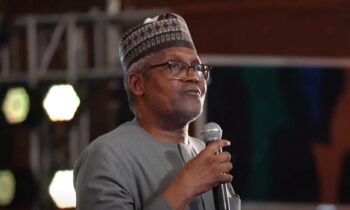
Other notable dignitaries at the event included Bill Gates Dangote; the Governor of Lagos State, Babajide Sanwo-Olu; and the Governor of Gombe State, Inuwa Yahaya, among others.
Meanwhile, the Chair of the Gates Foundation, Bill Gates, has said that the $100 billion spent by the foundation in the last 25 years to improve healthcare in Africa has helped to develop partnerships in Nigeria and other countries on the continent.
Gates disclosed this at Goalkeepers, a live event organised by the Gates Foundation in Lagos on Wednesday.
He explained that when the Foundation started in 2000, the basic guiding principle was that all lives have equal value, with a major concern about reducing infant mortality globally, especially in Africa.
“And so I looked and I said, okay. Are people taking this seriously, are they making the medicines cheaper, or are they tailoring the medicines to the particular needs of those areas, for example, investing in new malaria tools? And the answer was no.
“And so, that became the guiding light for the Gates Foundation. Over 70 per cent of what we’ve spent, the $100 billion we’ve spent in these last 25 years, went to global health, and throughout that 25 years, we’ve developed the partnerships, throughout Africa,” he said.
“Here in Nigeria, we’ve had amazing partners who understand the delivery and the way that we can work and help the government. The government, in the long run, has the responsibility for all of this work. We’re there to accelerate these systems,” he added.
Chair of the Gates Foundation, Bill Gates, and Gombe State Governor, Inuwa Yahaya (middle), at the Goalkeepers event in Lagos on Wednesday, June 4, 2025
Gates noted that improving health accelerates the economic growth of a country to a point where it can become self-sufficient. He expressed optimism that the global child mortality rate can be reduced by 50 per cent from the current five million cases worldwide.
He explained, “These next 20 years, you know, the countries in Africa will get to that status. So helping them accelerate that, helping them understand what the unique local challenges are, which things we need to make simpler, and bring the price down. That’s done, as a partnership, and the last 25 years went way better than I expected; that is, childhood death, globally and in Africa, was cut in more than half.
“We went from almost 10 million worldwide to now less than five million. And I feel confident we can cut that in half again, even though, as you mentioned, right now, we’re in a stunning and completely unjust withdrawal of support from a number of rich governments, including the United States, but even despite that, which is going to make the next four or five years, we’ll have some reversal because it’s just too large and too sudden to overcome. We will get back to incredible progress reducing those.”
New, Cheap Vaccines
The co-founder of Microsoft further stated that the number of children who die every year has gone down faster every year for the last 25 years, over three times faster than ever in history.
“And there’s some, you know, very key things that were done there. There were new vaccines that were made cheaper, like rotavirus, pneumococcus, penta. And Gavi is a group that helps fund most of those costs to make sure they get to all the world’s children.
“So that loan, the bed nets for malaria, the preventing HIV transmission from mother to child, you know, a little bit of progress on malnutrition, that will be a big thing in the years ahead. So all that came together, and people started looking at vaccine coverage, and various countries can compare their vaccine coverage,” Gates said.
He added, “There are some countries in Africa that have over 95 per cent vaccine coverage, better than the United States. There are some countries that only have like 50 per cent vaccine coverage.
“So, there is hope that we can still make progress even if there’s a decline in the best ideas from all over Africa and sharing them; that alone would be a gigantic thing.”