


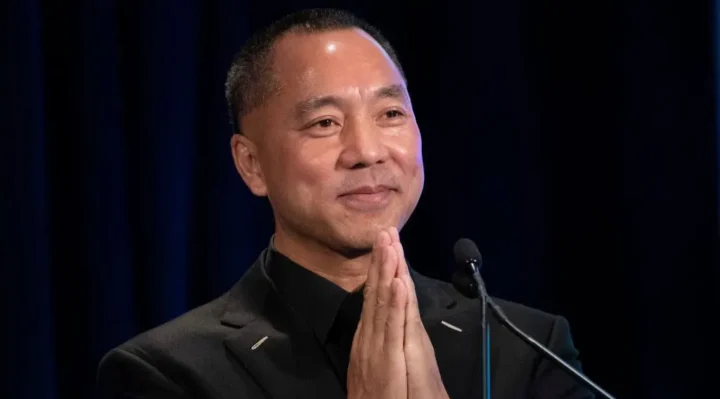


Chinese businessman and former property tycoon Guo Wengui, also known as Miles Guo and Ho Wan Kwok, has been sentenced to 30 years in a US federal prison after being convicted of orchestrating a more than $1 billion fraud and money laundering scheme that targeted thousands of his online followers.
A federal court in New York handed down the sentence after Guo was found guilty of racketeering, securities fraud, wire fraud, and money laundering linked to investment and cryptocurrency ventures promoted between 2018 and 2023.
US District Judge Analisa Torres said Guo had exploited supporters who believed in his pro-democracy campaign against China’s ruling Communist Party, using investor funds to finance an extravagant lifestyle instead of the promised ventures.
“He preyed on those seeking to bring democracy to China,” the judge said during sentencing.
Prosecutors: Investor Funds Paid for Luxury Assets
According to US prosecutors, Guo raised more than $1 billion from followers around the world through a network of investment and cryptocurrency offerings marketed to supporters of his political movement.
Authorities said the proceeds financed a portfolio of luxury assets, including:
- A 50,000-square-foot mansion
- A $37 million yacht
- A $1 million Lamborghini
- Other high-end personal expenditures
Prosecutors argued that the schemes were designed to enrich Guo rather than support the political causes or investment opportunities presented to contributors.
US Attorney Sean S. Buckley said the sentence underscores that financial crimes carry severe consequences regardless of wealth or public profile.
“Today’s sentence shows that fame and wealth do not place you above the law, and that fraudsters who victimise families to enrich themselves will be met with significant consequences,” Buckley said.
From Chinese Property Mogul to Political Dissident
Before leaving China in 2017, Guo built a fortune in real estate and maintained close ties with senior Chinese officials. He later fled the country after Chinese authorities accused him of corruption, allegations he denied.
After relocating to the United States, Guo reinvented himself as a vocal critic of the Chinese Communist Party, attracting a substantial following among Chinese diaspora communities through social media and political activism.
Guo maintained that the funds raised from supporters were intended to finance his pro-democracy activities, rejecting allegations that they were part of a fraudulent enterprise.
Political Connections Drew Wider Attention
Guo also became closely associated with Steve Bannon, the former adviser to US President Donald Trump. The pair frequently appeared together in online broadcasts and, in 2020, launched the New Federal State of China, a political movement advocating the overthrow of China’s Communist government.
Bannon was later arrested aboard Guo’s yacht in Connecticut in an unrelated fraud investigation connected to fundraising for a US-Mexico border wall project. While Bannon faced both state and federal legal proceedings, his federal prosecution ended after receiving a presidential pardon from Trump before leaving office.
Significance for Investors
The case has become one of the most prominent US prosecutions involving cross-border investment fraud tied to online political movements. It also highlights increasing regulatory scrutiny of fundraising campaigns involving cryptocurrency, digital assets, and investment schemes marketed through social media platforms.
The conviction serves as a warning to investors worldwide about the risks of unregulated investment offerings that rely heavily on political affiliation or online personalities rather than transparent financial oversight.
Source: BBC