




… Leaders demand stronger African institutions, local capital and globally competitive enterprises as young Africans are urged to take control of the continent’s narrative
Africa must move beyond exporting raw materials and depending on external capital, technology and institutions if it is to secure a more influential position in the global economy, leading African policymakers, financiers and business leaders have said.
They challenged the continent’s emerging generation of leaders to build productive economies, mobilise African capital, strengthen institutions and create businesses capable of competing globally rather than merely participating in global markets.
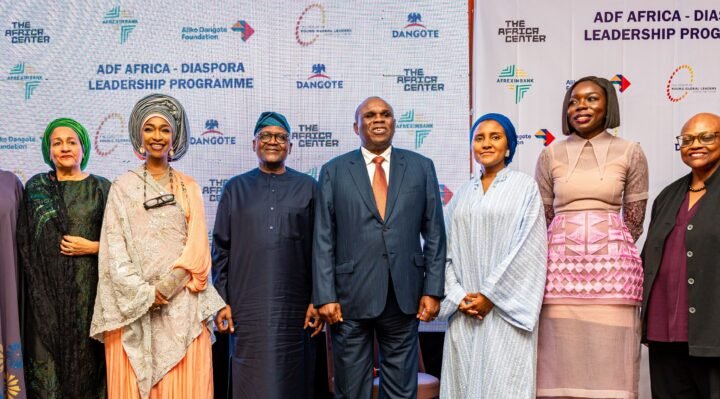
The call was made at the close of the 2026 Aliko Dangote Foundation Africa Diaspora Leadership Programme Young Global Leaders Convening in Lagos.
The four-day programme, held under the theme “Building Africa at Scale,” brought together Young Global Leaders from Africa and the diaspora for an immersion into Nigeria’s industrial, financial, technological and creative ecosystems.
Among those who addressed the gathering were United Nations Deputy Secretary-General Amina Mohammed; former President and Chairman of the Board of Directors of Afreximbank, Prof. Benedict Oramah; Nigeria’s Minister of Finance and Coordinating Minister of the Economy, Taiwo Oyedele; Minister of Art, Culture, Tourism and the Creative Economy, Hannatu Musawa; Chief Executive Officer of the Rwanda Development Board, Jean Guy Afrika; and Dangote Industries Limited President and Chief Executive, Aliko Dangote.
Their central message was clear: Africa’s next phase of development must be driven by ownership, production and institutional strength.
Rather than allowing the continent to remain defined by poverty, conflict, weak infrastructure and the export of natural resources, the leaders said Africa must develop the capacity to produce, finance and own the assets that will determine its economic future.
Amina Mohammed: Africa needs the power to write its own story
Mohammed said Africa’s struggle for greater global influence was no longer simply about representation but about power—particularly the power to shape decisions, institutions and narratives.
She urged young African leaders to move beyond the traditional demand for a “seat at the table” in global institutions and seek the ability to influence the decisions taken at those tables.
Reflecting on conversations with young Africans about representation at the United Nations, Mohammed said the aspiration was increasingly to have more than a seat.
“What we really want is the pen,” she quoted them as saying.
For Mohammed, the “pen” represents the power to determine Africa’s narrative rather than allowing others to define the continent.
She noted that African countries collectively constitute the largest regional grouping at the United Nations and therefore possess significant political weight. However, she argued that the continent has often approached international affairs as a recipient of decisions rather than as a strategic power capable of shaping them.
Africa, she said, must strengthen its institutions, coordinate its interests more effectively and deploy its collective economic and political influence.
She also warned that artificial intelligence was rapidly becoming another major source of global economic and geopolitical power and that Africa could not afford to remain on the sidelines.
Her message to the young leaders was blunt: “Don’t follow the status quo.”
She urged them to have the courage to challenge conventional thinking and turn their convictions into action.
Oramah: Dangote Refinery is helping Africa ‘take back its mind’
For Oramah, the significance of the Dangote Petroleum Refinery extends beyond its physical capacity to process crude oil.
He described the 650,000-barrel-per-day refinery as an important psychological breakthrough for Africa because it demonstrates that Africans can conceive, finance and execute complex industrial projects at global scale.
“The greatest thing that the Dangote Refinery has done and will do for us is our ability to take back our minds,” Oramah said.
He argued that the project was helping to undermine the long-standing perception that Africa lacked the technical, financial or managerial capacity to execute world-scale industrial ventures.
But he cautioned that one successful refinery was not enough.
Africa, he said, must build productive capacity across the economy.
“Unless we manufacture, unless we produce,” the former Afreximbank chief warned, the continent would continue to struggle to transform its position in the global economy.
His argument goes to the heart of Africa’s economic challenge: the continent possesses enormous natural resources but still imports a substantial share of the manufactured goods, refined products, machinery and technologies it consumes.
Oramah also called for a fundamental rethink of African finance, urging commercial banks to embrace what he described as “developmental commercial banking.”
African financial institutions, he said, must become more willing and capable of financing long-term productive investments rather than concentrating overwhelmingly on shorter-term commercial opportunities.
Oyedele: Create conditions for the next Dangote
Oyedele said the objective should not be to produce another Dangote by chance, but to create an economic environment in which large-scale entrepreneurs can emerge and succeed without having to overcome unnecessary institutional obstacles.
Describing Dangote as a “fighter”, the finance minister said his experience working closely with the industrialist had given him a greater appreciation of the persistence required to execute major investments in Nigeria.
“Until I got close to him, I saw that he was stressed more than the rest of us. But he would never give up,” Oyedele said.
He then posed a broader policy question: “What if we create the right conditions so that he will be less stressed, so that other people will be encouraged to do the same thing?”
That, he argued, should be one of government’s central economic responsibilities.
Government, according to Oyedele, should provide a predictable policy and regulatory environment in which private capital can finance businesses, create jobs, drive innovation and develop commercially viable infrastructure.
He also acknowledged that economic reforms cannot be judged solely by macroeconomic statistics.
For ordinary Africans, he said, reforms must ultimately translate into better living standards and economic opportunities.
Oyedele further warned that Africa pays an economic cost for the negative perceptions attached to the continent, describing this burden as a “stereotype tax,” “narrative cost” and “prejudice premium.”
Changing the narrative, he argued, is therefore not merely a public-relations exercise. It has direct economic consequences for investment, financing costs and the ability of African businesses to compete globally.
Rwanda: Africa must build systems, not depend on exceptional individuals
Afrika of the Rwanda Development Board offered perhaps one of the strongest institutional warnings of the gathering.
While acknowledging the scale of Dangote’s achievement, he argued that Africa should not build an economic model that requires every major investor to possess extraordinary patience, financial strength or political and institutional access to succeed.
“What Alhaji Dangote has done on the refinery is incredible,” Afrika said. “But truth be told, I think we get one in almost every lifetime.”
The bigger question, he said, was how to create systems where the next investor does not need exceptional access or exceptional patience to complete a major project.
He identified policy predictability, respect for contracts, institutional accountability and the preparation of investable projects as essential ingredients for attracting and retaining capital.
The message was particularly relevant to Africa’s infrastructure deficit, where projects can spend years navigating regulatory approvals, financing constraints, land issues and institutional uncertainty before reaching financial close.
For Afrika, sustainable development requires systems that make successful investment repeatable rather than dependent on exceptional individuals.
Musawa: Africa must monetise its cultural power
Musawa said Africa’s economic transformation must also include the creative economy.
She argued that culture is not simply an instrument for preserving heritage but an economic asset capable of generating employment, attracting investment and influencing how the continent is perceived internationally.
She urged Africans to take ownership of their stories and build cultural industries capable of competing in global markets.
“We need to take a hold of our narrative,” Musawa said.
The creative economy, she suggested, offers Africa another opportunity to convert its demographic and cultural strength into economic value, particularly as global demand for African music, film, fashion, art, literature and digital content continues to expand.
Dangote: The next generation must build the ‘New Africa’
Dangote challenged the young leaders to move beyond discussions about Africa’s potential and focus on execution.
“What you have seen in Lagos is that Africa’s challenge is not a shortage of ideas or ambition. It is turning ambition into institutions, productive capacity and lasting value,” he said.
He urged participants to consider not only what Africa could become but also the role each of them would play in creating what he called the “New Africa.”
The challenge reflects the broader philosophy behind the Aliko Dangote Foundation’s Young Global Leaders initiative.
According to the Foundation’s Managing Director and Chief Executive Officer, Zouera Youssoufou, the organisation has supported African members of the World Economic Forum’s Forum of Young Global Leaders for 15 years to increase the continent’s representation and influence within global leadership networks.
She said the Foundation specifically supports African Young Global Leaders to participate fully in the programme and its learning journeys, giving them access to knowledge, networks and experiences that can strengthen their ability to make an impact in Africa.
“This year, we decided to host the Young Global Leaders here in Lagos. The learning journey focuses on the rise of African excellence and what it takes to build Africa at scale,” Youssoufou said.
She said the objective was for participants to leave Nigeria with a stronger conviction that transformative African enterprises were possible and that they could also aspire to build businesses and institutions at comparable scale.
From potential to ownership
The Lagos gathering ultimately presented a common diagnosis of Africa’s development challenge.
The continent does not lack natural resources, entrepreneurial ambition, a young population or ideas. Its bigger challenge is converting these advantages into ownership, productive capacity, capital formation and globally competitive institutions.
That transformation will require more than government policy or individual entrepreneurship.
It will require African banks to finance African businesses, governments to provide predictable rules, entrepreneurs to invest for the long term, institutions to become more accountable and young leaders to challenge systems that perpetuate dependence.
The Dangote Refinery was repeatedly invoked as an example of what is possible when capital, ambition, persistence and industrial execution converge.
But the stronger challenge from the speakers was to make such achievements less exceptional.
For Africa, the real measure of progress may therefore not be whether another extraordinary entrepreneur emerges, but whether the continent can build an economic and institutional system in which extraordinary projects become increasingly ordinary.
That is the larger meaning of “Building Africa at Scale”: moving from a continent rich in potential to one that increasingly builds, finances, owns and controls its future.