


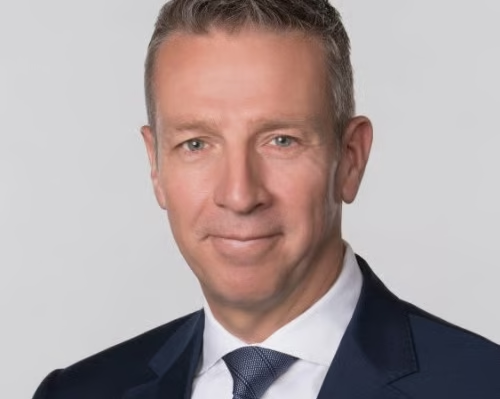


As Marno de Jong ends his tenure as Shell Nigeria’s Executive Vice President and Country Chair, the veteran energy executive reflects on the lessons, investments and leadership challenges that shaped one of the company’s most consequential periods in Nigeria.
By the time this article is published, Marno de Jong, who has completed more than six years in Nigeria as a senior Shell executive, may already be preparing for his next assignment in the Middle East.
But the Dutch energy executive left Nigeria with one message that suggested his relationship with the country may not be over.
“Don’t place a bet that you won’t see me in Nigeria again,” he told guests at a farewell reception in Lagos marking the end of his tenure. “If there is one thing I have learned, it is never to underestimate where life’s journey might take you next.”
The remark drew applause—and perhaps a knowing nod from colleagues who have watched a career spanning more than three decades take him across continents.
For Shell, however, de Jong’s departure represents more than the end of another executive posting. It marks a leadership transition following a period of significant operational, investment and portfolio changes in one of the world’s most strategically important oil and gas markets.
A global career shaped by energy
De Jong’s career has taken him through the United Kingdom, Venezuela, Nigeria, Australia, the United States, the Netherlands, Malaysia and Indonesia.
A first-class physics graduate, he joined Shell in 1992 as a project engineer and subsequently held positions spanning project delivery, engineering, commercial activities, upstream development, asset management and country leadership.
Nigeria featured twice in that journey.
His first posting to the country came in 1998, when he served as Head of Front-End Engineering. He subsequently moved to international assignments in Australia and Indonesia before returning to Nigeria in 2020 as Senior Vice President.
Looking back on that return, de Jong said the scale of the second Nigerian chapter was something he could not have predicted when he first arrived more than two decades earlier.
“At the time of my first posting to Nigeria, I could never have imagined that more than two decades later I would return to lead Shell’s businesses and spend some of the most rewarding years of my career here,” he said.
Delivering performance in a challenging operating environment
De Jong’s second tenure coincided with a period of profound change in Nigeria’s oil and gas industry.
Under his leadership, Shell’s flagship Bonga production asset maintained availability above its 92% target, while the company advanced major capital investment decisions involving projects such as Bonga North and offshore gas developments.
He also served on the board of Nigeria LNG Limited (NLNG), where he contributed to the implementation of the Train 7 expansion project, one of Nigeria’s most significant ongoing gas investments.
These projects are strategically important beyond Shell’s portfolio. Nigeria is seeking to increase gas utilisation, expand domestic energy supply and strengthen its position in global liquefied natural gas markets at a time when energy security has become a central concern for governments and investors worldwide.
SPDC divestment reshapes Shell’s Nigerian portfolio
Perhaps the most consequential corporate development during de Jong’s Nigerian tenure was Shell’s divestment of its onshore subsidiary, The Shell Petroleum Development Company of Nigeria Limited (SPDC).
The transaction marked a major restructuring of Shell’s upstream portfolio in Nigeria after decades of operations in the country’s onshore oil industry.
De Jong described the completion of the transaction as one of the defining achievements of his tenure.
“We successfully completed the SPDC divestment and laid the foundations for a new future through Renaissance,” he said.
The transaction transferred the business to Renaissance Africa Energy Company, while Shell retained a significant focus on its deepwater and integrated gas businesses in Nigeria.
The shift illustrates the broader transformation taking place across Nigeria’s upstream industry, as international oil companies reassess mature onshore portfolios while concentrating capital on deepwater, gas and other assets where they see stronger long-term potential.
Leadership praised for performance and people management
At the Lagos farewell event, colleagues, government officials and industry leaders praised de Jong’s leadership style and contribution to Nigeria’s energy industry.
Shell Chief Executive Officer Wael Sawan, in a recorded farewell message, described de Jong’s approach to performance as admirable.
Shell’s Upstream President, Peter Costello, also highlighted what he described as de Jong’s ability to combine performance expectations with openness and thoughtful decision-making.
“He is calm under pressure. He is thoughtful in his judgement. He brings a strong performance mindset, but he also creates space for people to speak up,” Costello said.
Nigeria’s Minister of Trade and Investment, Jumoke Oduwole, said Shell’s investments during de Jong’s tenure aligned with the Federal Government’s Renewed Hope economic agenda.
The Group Chief Executive Officer of the Nigerian National Petroleum Company Limited, Bayo Ojulari, represented at the event by Executive Vice President, Upstream, Udobong Ntia, also commended de Jong for contributing to efforts to advance the role of gas in Nigeria’s energy future.
Elohor Aiboni takes over historic Shell Nigeria role
The farewell also marked the beginning of a new chapter for Shell Nigeria.
De Jong formally handed over leadership to Elohor Aiboni, who returns to Nigeria from an international assignment in Brunei.
Aiboni previously worked with de Jong as Managing Director of Shell Nigeria Exploration and Production Company (SNEPCo) before leaving Nigeria for her international assignment in 2024.
Her appointment is historic. She becomes the first woman to lead Shell’s businesses in Nigeria and the first Nigerian to simultaneously occupy the positions of Executive Vice President Nigeria and Country Chair.
Aiboni said de Jong had demonstrated that strong performance could be achieved alongside respect, trust and effective people management.
“What I have always appreciated about Marno is that he combines performance with care,” she said. “He is very clear on outcomes, but he is also deeply respectful of people. He challenges teams to raise the bar, but he does it in a way that builds confidence, ownership, and trust.”
Her appointment also comes as Shell Nigeria enters a new phase following the restructuring of its upstream portfolio and the company’s continuing focus on deepwater, gas and lower-carbon opportunities.
“Together, we have written a new chapter”
For de Jong, however, the most important measure of his Nigerian tenure was not simply the projects delivered or corporate transactions completed.
It was the people behind them.
“When I returned in 2020, I arrived at a time of enormous change, uncertainty, and opportunity,” he said.
“Looking back today, what stands out most is not the challenges we faced, but the people who helped us overcome them. Together, we have written a new chapter for Shell in Nigeria.”
That emphasis on teamwork was also evident in his acknowledgement of his family, who accompanied him through a career defined by international postings and constant changes in location.
“Anyone who has worked in this industry knows that careers like ours are never individual journeys,” he said. “They are family journeys.”
He credited his family for supporting the moves, assignments and unexpected changes that came with a global energy career.
What Nigeria taught a global energy executive
Perhaps the most revealing part of de Jong’s farewell was his assessment of what Nigeria taught him personally and professionally.
“Nigeria taught me many things,” he said. “It taught me patience. It taught me resilience. It taught me the importance of listening.”
But the most important lesson, he suggested, was the value of collective action.
“Above all, it reinforced my belief that progress happens when people come together around a shared purpose.”
That lesson has implications beyond one executive’s career.
Nigeria remains one of Africa’s largest energy markets, with enormous oil and gas resources but equally significant infrastructure, investment and policy challenges. For international energy companies, success increasingly depends not only on capital and technical expertise, but also on the ability to navigate regulatory change, build partnerships and develop local leadership.
De Jong’s six-plus years in Nigeria therefore offer a snapshot of an industry in transition—from traditional oil production towards a portfolio increasingly shaped by deepwater, gas, energy security, investment discipline and changing ownership structures.
A new era for Shell in Nigeria
As de Jong moves on, Shell Nigeria enters its next chapter under Aiboni, at a time when the country’s energy industry is being reshaped by reforms, new investment models and growing emphasis on gas and domestic energy security.
For Shell, the strategy is evolving. For Nigeria, the challenge remains converting its vast energy resources into reliable energy supply, industrial growth, government revenue and broader economic development.
De Jong leaves behind a record defined by major projects, portfolio restructuring and a leadership transition that places a Nigerian woman at the centre of Shell’s operations in the country.
And if his farewell message is anything to go by, Nigeria may not have seen the last of him.
“Don’t place a bet that you won’t see me in Nigeria again.”
For a country that has already featured twice in his global career, the odds may well be worth considering